

I absolutely love hearing the stories about each and every one of you, my fellow doll clothes sewing enthusiasts! For example, on Wednesday, July 23rd, I asked you what you were working on, and I got some really cool responses! (If you didn’t see the comments, you should really go back to that blog post and read through all of them!)
From those little “Sewing Chat” blog posts, I know that many of you frequent second-hand stores, searching for dolls you can clean and dress. Some of you sell them. Others donate them to charities. I sometimes do this as well, but most of the time I don’t really need more dolls. Rather, for the purpose of this website, I really only need one of each doll, in order to design clothes for them.
*Please note: when you click on links to various merchants on this site and make a purchase, this can result in this site earning a commission. Affiliate programs and affiliations include Amazon, Etsy, and the eBay Partner Network. As an Amazon affiliate, I earn from qualifying purchases. To learn more about how my website uses affiliate marketing, please visit the website’s Privacy Policy page.

When I visit a second-hand store, the real treasures are old sewing patterns for making dolls’ clothes! When I find them, I take them home, take the patterns and instructions out of the envelope, read the instructions, and consider using the patterns for alterations that I will learn from and later transform into my own uniquely drafted sewing patterns, inspired by but not identical to the commercial patterns I started with.
Well on Tuesday last week, I drove two hours to Boise to pick up my brother at the airport, and you know how it is with airports… It’s better to leave your house early, just in case you encounter a traffic kerfuffle. And since I was driving two hours, I left a spare two hours early.
Which left me wandering around Boise, wondering what to do with myself while I waited for my brother’s plane to land. So of course, I went to some second-hand stores.

I can learn a LOT from the different ways a designer can piece together a pattern. For example, some doll clothes patterns will have you sew a sleeve together at the underarm-to-cuff seam first before attempting to fit the sleeve to the bodice; others will have you attach the shoulder’s rounded, usually U-shaped part of the sleeve to the shoulder area of the bodice before you sew from cuff to underarm and then down the side seam of the bodice.
For those of you who watch my videos a lot, I bet you can guess which of those two methods is my favorite!
But I digress…
While I was waiting for my brother in Boise, I went into a second-hand store and asked one of the ladies who worked there, “If I were an old sewing pattern, where would I be?”

When she pointed to the stash of old vintage sewing patterns taking up a big chunk of her shelf space, my eyes just about popped out of my head! It was a treasure-trove, and right on top, I found some doll clothes patterns right off the bat!
There were two vintage patterns for Ideal Crissy dolls, lots of doll clothes patterns from the 1980’s, but the real gems were a Simplicity 3406 for 18 inch baby dolls — I can’t find a date on it, but it looks like it’s from the 1950’s and…
Do you see it right on the top of this stack of old patterns I brought home?

Yep! That pattern in the lower right-hand corner is a vintage Simplicity 2538 for 16 inch little girl dolls, from the 1940’s! Wow! It was MY LUCKY DAY!
It gets even better…
The Simplicity 2538 looks like it’s an uncut pattern! I still need to inspect it more closely, but wow!

Do you see the name at the very top of the pattern? It says, “Donna McMillen.”
Donna’s name appears in about one-third of the twenty-one patterns I found that day. And while I waited for my brother at the airport, I couldn’t help but look through these lovely patterns. I discovered that Donna very likely was a tracer of patterns because most of her patterns (including this vintage Simplicity 2538) were uncut, but not factory folded.
What do I mean by that? The patterns were wadded up inside the envelope, but they didn’t look like anyone had ever cut them out. How can that be?
There are people who don’t cut their tissue paper patterns. Instead, they trace them onto tracing paper or other tissue paper, to keep the original pattern in tact. Here’s a pattern I traced and altered, for example:

Tracing your pattern can make it easy to alter your patterns without damaging the original pattern. In the example above, I wanted to shorten the doll’s skirt, but I didn’t want to cut the original pattern along the new hemline. So instead, I traced the original pattern but brought the hem up a couple of centimeters on my traced version.
The other name that appeared on about a third of my newly acquired patterns was “Gladys Marsh.” While I sat in the Boise Airport, waiting for my brother, I took out some of Gladys’s patterns.
I was really just counting to see if all the pieces were there, but guess what I discovered about Gladys…

Gladys was METICULOUS about cutting out her patterns exactly right! “Way to go, Gladys!” (I actually said that out loud in the airport, while I was looking through these patterns!)
So these two patterns, Simplicity 5276 and Simplicity 9138 for Ideal Crissy dolls, along with several other patterns in Gladys Marsh’s collection were complete patterns with perfectly cut-out pieces and all of their instructions.
To me, that’s even better than an uncut pattern, especially since each pattern was cut with such delicate care and kept safe and in the right envelopes. WOW. What a treasure!

Of course there’s no way to know why Gladys, Donna, someone named Terry, or any of the other sewists gave up their patterns. Since they were so well cared for, I can’t imagine these ladies just giving up their beloved patterns for no reason whatsoever. But their reasons will be forever shrouded in mystery.
As I sat in the airport, thinking about these ladies who shared my passion for sewing doll clothes, I wondered if they had passed.
And if so, had their angelic spirits guided me to that second-hand store, nudging me in the right direction? Were they hoping I was someone who would appreciate all the care they took in keeping and using these patterns over the years? I get a chill as I type this, which tells me yes, that’s probably the case.
Bless you both, Gladys and Donna. And everyone else who takes good care of their beloved patterns. When I pass, I hope my collection of vintage patterns will go to someone who will be equally pleased by the tender care I’ve given each one.

Most of the commercial patterns I display and talk about here on ChellyWood.com are also available for sale on eBay. However, if you’ve never purchased a pattern on eBay before, it’s a good idea to read the article I wrote called, “Tips for Buying Used Doll Clothes Patterns on eBay.” It will save you time, money, and will likely prevent buyer’s remorse.
And by the way, if you use the links I’ve provided to make your eBay purchase, this website will receive a small commission, which helps fund the ChellyWood.com website, so I can continue to provide you with all the free patterns and tutorial videos offered here.
For more of my free tutorials, be sure to subscribe to my YouTube channel, ChellyWood1.
If you would like to make a donation to this free doll clothes pattern website, please click here. There’s also a “Donate” button in the main menu.
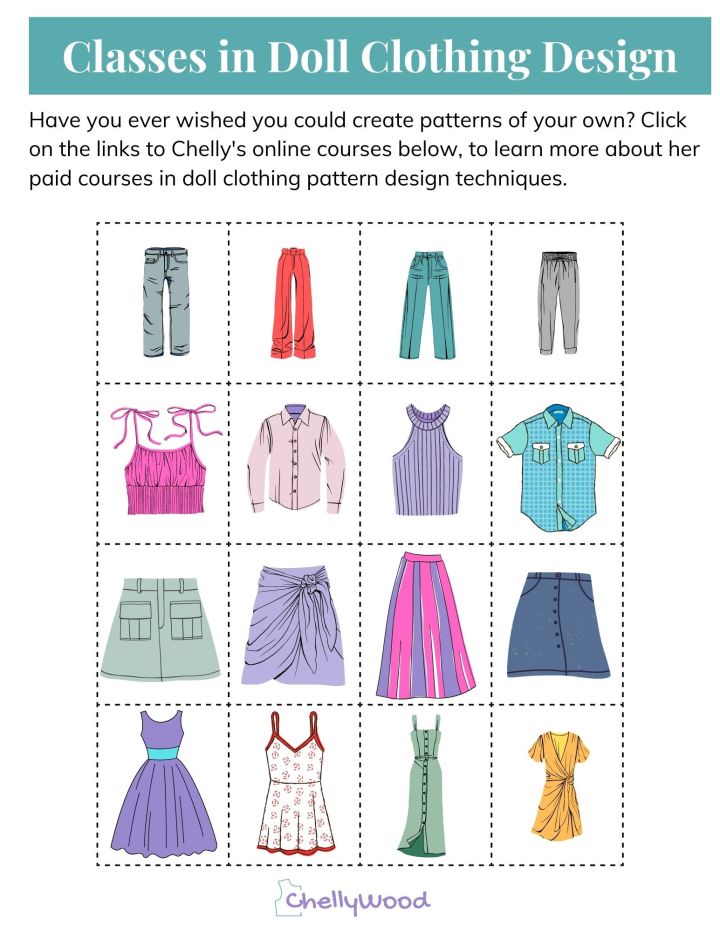
For anyone who would like to expand their dolls’ wardrobes, you should really check out my “How to Alter Doll Clothes Patterns” course and my “Design Your Own Doll Pants Patterns from Scratch” classes on the Creative Spark online learning platform. Here’s my bio page on their website, where you can learn more.
For any class on Creative Spark, you don’t have to follow a schedule. Just sign up when you’re ready.
It’s a one-time fee for the course, and there’s no specific time limit to finish your course. You can just take your time and learn at the pace that suits you. So go check out my paid courses on Creative Spark, using this link.
As always, feel free to pin, like, or tweet about my free patterns and tutorials.
To read more about my free sewing patterns and tutorials, please visit the “Helpful Tips” page.
Disclaimer/Credit/Affiliate Marketing Link:
*Please note: when you click on links to various merchants on this site and make a purchase, this can result in this site earning a commission. Affiliate programs and affiliations include Amazon, Etsy, and the eBay Partner Network. As an Amazon affiliate, I earn from qualifying purchases. To learn more about how my website uses affiliate marketing, please visit the website’s Privacy Policy page.
Chelly Wood and the ChellyWood.com website are not affiliated with the pattern company or companies mentioned in this blog post, but Chelly finds inspiration in the doll clothes designed by these pattern companies. To purchase patterns from Simplicity, McCall’s, Butterick, Vogue, or other pattern companies shown and discussed in this blog post, please click on the links provided here. These links below the “Disclaimer” section do not help raise money for this free pattern website; they are only offered to give credit to the company that made these patterns.
A real treasure! I always keep my patterns uncut. I prefer to scan and print them.
I’ve always been scared for how thin and fragile is that old paper!
Here in Italy doll patterns are rare and even big second hand shops don’t have patterns, very often they reduce even their space for books.
I’m also planning to give away few Barbies I don’t like for a charity or something organized by the company I’m working for. I’m planning to sew 3 outfits for doll and it is not easy at all.
Here in the United States, some second-hand stores don’t sell their patterns to the general public; instead, they list them on eBay. So this was an incredible find!
Ciao, Marco!
Here in Brazil doll patterns are really rare, as well. Human-sized patterns were usually sold in specialized fashion magazines, and once in awhile they published a pattern for the doll that was all the rage back then, a dolly-and-me kind of pattern, or a kids magazine published a doll pattern. But you would have to know what issues have dolls patterns to look for them. I think home made doll clothes were made in a quite intuitive way.
Oh, Chelly, what a lovely post! You know, Marie Kondo, the Japanese organizing consultant, says that we “borrow” something of us to the things that belong to us, just like our shoes end up shaped like our feet. So, I think even those who don’t believe our souls go on can feel these ladies left their mark on these patterns. I hope they are smiling in heaven, knowing that they patterns are being as appreciated as they did!
😇