

Two weeks ago I posted the first of a series of questions from one of my followers, Kim. Today’s blog post addresses the third of Kim’s questions, and today I’ll be addressing her question and my answer here, on ChellyWood.com, as the third blog post in a four-part blog post series.
Before I do that, though, I need to make my official “Affiliate Marketing Disclaimer” statement: when you click on links to various merchants on this site and make a purchase, this can result in this site earning a commission. Affiliate programs and affiliations include Amazon, JoAnn Fabric, Etsy, and the eBay Partner Network. As an Amazon affiliate, I earn from qualifying purchases. To learn more about how my website uses affiliate marketing, please visit the website’s Privacy Policy page.

Kim’s third question was: “Do I need to learn how to read life-sized commercial patterns etc., to learn how to make doll clothing, or can I just get some fabrics together and just start sewing?”
And this is how I answered:
When we read commercial patterns, we learn about concepts like grainlines, notches, darts, seam allowances, gather lines, and cutting on the fold. You can learn all of these concepts from YouTube, but I think you will probably learn them faster when you purchase and sew a commercial pattern.

My patterns are free, and since I don’t charge people for them, I don’t feel obligated to include notches, grainlines, and a packet of written instructions for my patterns. Some of my older patterns on my website don’t even have seam lines because I started my blog as a personal journey, not realizing that people might one day want to download my patterns. (I’m trying to update those older patterns, though, to include the seam lines.)
However, when I began designing commercial doll clothes sewing patterns for a doll company (Lammily), I had to include concepts that you would expect to see in any commercial sewing pattern, like notches (these help you match seams up), grainlines (which tell people which direction the weave of the fabric goes), and written instructions (for people who prefer to read the directions rather than following a video tutorial).

It certainly doesn’t hurt to learn how to make doll clothes from commercial patterns, but honestly, you do not need to learn how to read life-sized commercial sewing patterns in order to design your own doll clothing.
I didn’t start making my own human-sized clothing until I was in high school, and by that time, I’d already learned how to design my own doll clothes patterns long before. At age 14 I designed my own Renaissance gown for Barbie, complete with an Elizabethan ruff and mutton sleeves, even though I’d barely begun to sew my own clothing for myself.

Reading the written directions for making doll clothes patterns did help me a lot though. The first doll clothes sewing pattern that I owned was Simplicity 4883 for Ideal Tammy dolls. I did not own a Tammy though. I only owned Barbies, Ken, and one Kenner Dusty doll.
So from age 10 up, I always had to alter my patterns, in order to make them fit my Barbie dolls properly.
Reading the written directions helped me understand how to piece the garment sections together, so as I made alterations to those patterns, I kept in mind the ways in which each piece would be fitted to the next.

So to answer your question directly, if you wish to design doll clothes patterns that you want to sell to a sewing audience, then you would definitely need to learn how to read and understand the vocabulary used for commercial patterns.
They could be commercial doll clothes sewing patterns though. They wouldn’t necessarily have to be human-sized clothing patterns.
If anyone reading this would like to add to the discussion, feel free to leave your thoughts in the comments! Please leave a comment letting us know what you advise for Kim.

For anyone who is truly ready to expand their dolls’ wardrobes beyond the patterns you’ve already collected in your sewing adventures, it certainly wouldn’t hurt to check out my “How to Alter Doll Clothes Patterns” course and my “Design Your Own Doll Pants Patterns from Scratch” class on the Creative Spark online learning platform. Here’s my bio page on their website, where you can learn more.
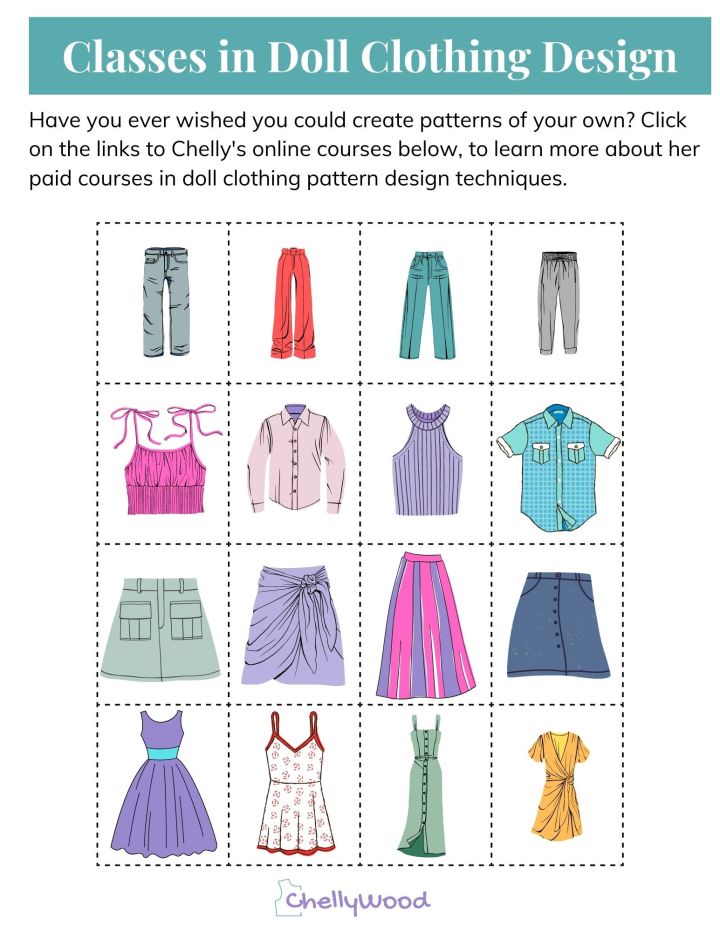
For any class on Creative Spark, you don’t have to follow a schedule. Just sign up when you’re ready.
It’s a one-time fee for the course, and there’s no specific time limit to finish your course. You can just take your time and learn at the pace that suits you. You can check out my Creative Spark courses, using this link.
Disclaimer/Credit/Affiliate Marketing Link:
*Please note: when you click on links to various merchants on this site and make a purchase, this can result in this site earning a commission. Affiliate programs and affiliations include Amazon, JoAnn Fabric, Etsy, and the eBay Partner Network. As an Amazon affiliate, I earn from qualifying purchases. To learn more about how my website uses affiliate marketing, please visit the website’s Privacy Policy page.
Chelly Wood and the ChellyWood.com website are not affiliated with any of the doll or toy companies mentioned or shown in this blog post, but Chelly enjoys designing her doll clothes to fit a variety of dolls. To learn more about the doll companies mentioned in today’s post, please visit the doll or toy company’s website.
I do agree with your answer. Personally, I like making doll clothes only, I have never thought to make anything for me, just a bandana or a bag. I don’t know, maybe I’m just scared that my cloth could fall unstitched. I suppose doll clothes are somehow different from real size ones. Could you imagine making a felt shirt for yourself? 🙂
Learning how to read patterns is really useful anyway. I love printed patterns, they are so technical! Maybe because I’m an architect. Patterns give us a lot of informations.
If a person wants to start making patterns and specifically if this person wants to sell them professionally I’d suggest her/him to learn at least the basics. Customers can be cruel. I can remember long discussions about a doll dress if it had to be lined or not. Professionally made patterns must be simply perfect.
Yes, in order to continue to be offered contracts for professionally made doll clothes, a designer needs to be able to fulfill the design requirements of the company they’re contracting with. Some companies are less restrictive than others, but there are industry standards too, and a professional designer needs to be familiar with those industry standards.
Good discussion, Marco. Thank you for your contribution to the discussion!