

Last Wednesday I posted the first of a series of questions from one of my followers, Kim. Today’s blog post addresses the second of Kim’s questions, and today I’ll be addressing her question and my answer here, on ChellyWood.com, as the second blog post in a four-part blog post series.
But I want to hear the opinions of my followers as well, so please read all the way to the end!
Kim’s question was: “Do I need to first learn how to make life-sized clothing by taking sewing classes, in order to learn how to make doll clothes, or can I just make doll clothing without that information?”

Now before I go on, I need to make my official “Affiliate Marketing Disclaimer” statement: when you click on links to various merchants on this site and make a purchase, this can result in this site earning a commission. Affiliate programs and affiliations include Amazon, JoAnn Fabric, Etsy, and the eBay Partner Network. As an Amazon affiliate, I earn from qualifying purchases. To learn more about how my website uses affiliate marketing, please visit the website’s Privacy Policy page.
Kim’s question is one I’ve been asked before, so I thought it was a perfect opportunity to share with my audience at large. This is how I replied…
It certainly doesn’t hurt to take in-person sewing courses at your local fabric or craft stores, if they’re being offered. Online lessons are helpful, yes, but in-person classes offer you a chance to ask questions in real time, making the lessons stick in your brain in a way that online classes usually don’t.

Kim’s email also asked whether or not she would need to know how to sew clothes for people, in order to get the most out of my online classes, so I addressed that aspect of her question as well…
My class on doll clothing design offers more than 40 videos, showing different techniques to help you alter shirts, pants, skirts, and dresses for dolls. I teach you how to re-shape a garment so it fits properly; how to lengthen and shorten pants; how to make skirts shorter, longer, fuller, or more tight-fitting (like a pencil skirt); how to extend the back closure with a gusset, to make sure all garments fit eventually, even if your first design fits too tightly. The class also shows you how to enlarge and reduce patterns that you already own. That’s pretty extensive!
But what you can do with that information is going to be dependent upon the techniques you already know. For example, do you already know how to turn a normal sleeve shape into a mutton sleeve? If not, you may struggle to make a mutton sleeve for a doll dress that you’re trying to design.

However it will give you the foundation to help you try making mutton sleeves for your dolls. If you have had the hands-on practice of measuring your doll for a sleeve (having taken my class), and you’ve learned how to alter sleeve lengths (also provided in a section of my class), then you may be able to take an existing pattern for a mutton sleeve for Barbie (for example, the sleeve for the Barbie wedding dress in Vogue Craft pattern 9985) and make changes to that pattern so it fits a different doll, like Blythe.
The re-sizing formula that I teach in my course would help you start to resize the pattern, and the lessons I give on measurement and sleeve variations would allow you to alter the sleeve from there.
But will you be able to design your own mutton sleeve from scratch? Probably not. You would need to have a basic mutton sleeve design shape to work from. You would also need to have the background information that lets you know this type of sleeve is called a “mutton sleeve” so you could go online to find an example of a mutton sleeve design to work with.

To remind you, the question Kim asked was, “Do I need to first learn how to make life size clothing by taking sewing classes in order to learn how to make doll clothes, or can I just make doll clothing without that information?”
My answer is this: In order to know the terminology (like mutton sleeve), you would need to have taken some sewing classes that give you access to that type of vocabulary. You would not need to have had experience making human-sized clothing for this necessarily, but that is how most people learn these fashion-related terms.
If anyone reading this would like to add to the discussion, feel free to leave your thoughts in the comments! Did you learn to sew doll clothes first, or did you learn to sew clothing for life-sized people first? And how did you learn the sewing vocabulary that you know today? Please leave a comment letting us know what you advise for Kim.


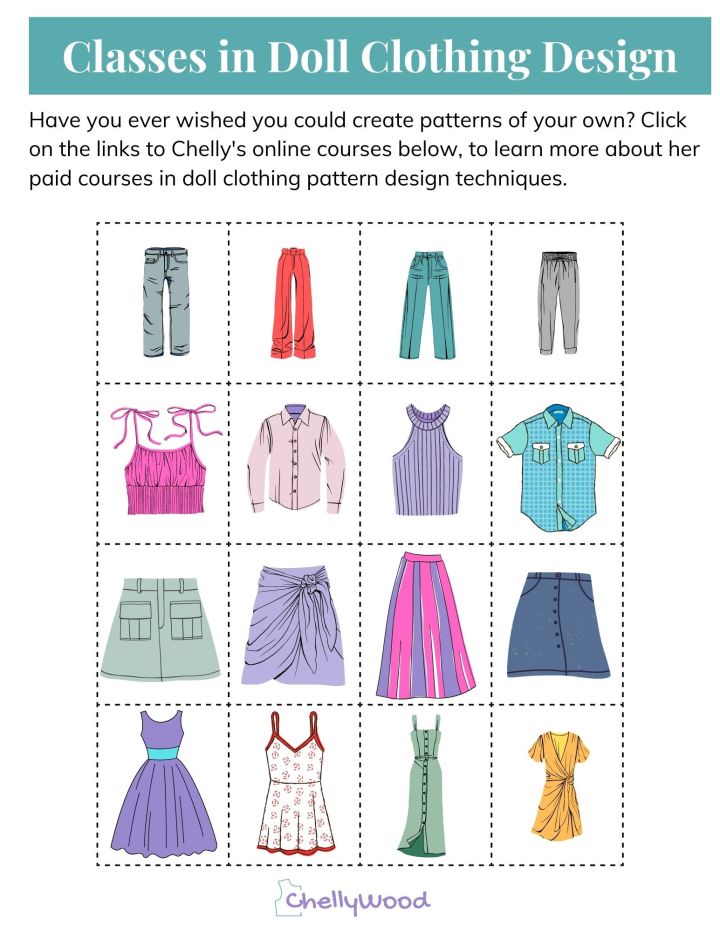
For anyone who is truly ready to expand their dolls’ wardrobes beyond the patterns you’ve already collected in your sewing adventures, it certainly wouldn’t hurt to check out my “How to Alter Doll Clothes Patterns” course and my “Design Your Own Doll Pants Patterns from Scratch” class on the Creative Spark online learning platform. Here’s my bio page on their website, where you can learn more.
For any class on Creative Spark, you don’t have to follow a schedule. Just sign up when you’re ready.
It’s a one-time fee for the course, and there’s no specific time limit to finish your course. You can just take your time and learn at the pace that suits you. You can check out my Creative Spark courses, using this link.
Disclaimer/Credit/Affiliate Marketing Link:
*Please note: when you click on links to various merchants on this site and make a purchase, this can result in this site earning a commission. Affiliate programs and affiliations include Amazon, JoAnn Fabric, Etsy, and the eBay Partner Network. As an Amazon affiliate, I earn from qualifying purchases. To learn more about how my website uses affiliate marketing, please visit the website’s Privacy Policy page.
Chelly Wood and the ChellyWood.com website are not affiliated with any of the doll or toy companies mentioned or shown in this blog post, but Chelly enjoys designing her doll clothes to fit a variety of dolls. To learn more about the doll companies mentioned in today’s post, please visit the doll or toy company’s website.
I learned to sew for people first. I am old enough that Home Economics was offered in high school but I never took it until my senior year and ended up with cooking first instead of sewing. I did make a dress when I was 14 with help from my friends who did take sewing. After I married at 17 with a mother- and sister-in-law who sewed I had to teach myself. I am still awaiting my first doll garment after preparing since 2017 the year I retired.
Thanks for sharing your story, Judy. I’ve been working in education for 30 years, and one of the saddest things that came out of the No Child Left Behind Act was the loss of arts and crafts in the school system. Even though there were reforms to the law passed in 2010, school districts still de-value the teachers who teach home economics, art, choir, band, etc. and yet, these teachers dedicate many after-school hours to their arts/crafts. When budgets get cut, these are the subjects that are taken out of schools; these are the teachers who are not replaced when they retire, making schools more academic but a lot less for fun children.
And what we all need to remember is that they are, in fact, children.
I learned to sew by making doll things when I was a kid, and in comparison to human stuff now find it’s trickier handling the little tiny seams and the little tiny pieces and the little tiny details, and think it would perhaps be easier to learn to sew for humans first. I didn’t know that then because I had no frame of reference. But by all means, if you don’t have any interest in sewing human stuff, don’t. Learning to sew is learning to sew and it doesn’t matter which you learn first. My best recommendation for everybody is to get a good sewing book and simply read through it. You learn terms, you come to understand the order of assembling a garment, and you have some understanding of alterations. If you want to practice any of it, it certainly takes less fabric and time to try it on doll things. Enjoy!