

My grandma always called it “stuffing,” like the breaded food that you fill a turkey with on Thanksgiving, but at my local fabric store, they refer to the fluffy filling we put inside plush toys as “fiber fill.”
The stuffing I tend to buy is made of polyester fibers, so I suppose the words “fiber fill” adequately explain both the product and what you do with it.
And there’s a LOT you can do with it!

You can make plushies, or as we used to call them, “stuffed animals,” of course, in a wide variety of styles and animal types. They can be realistic, like the owl that appears on the far left above, or fantastical, like the goat-girl wearing the pink dress above.
The little elf on the far right is considered more of a “rag doll,” or at least, that’s how my family differentiated between different types of plushies. It was only a “stuffed animal” if it was meant to look like an animal.
However, in the picture above, the goat-girl is a little confusing. Is she a stuffed animal? Or is she a rag doll? She’s a little of both, I think, so the word “plushie” seems to encompass all kinds of stuffed creatures.

Some of you know that in my “day job,” I’m actually a school librarian. As such, I’m in charge of the school yearbook/annual, and I teach a class wherein eight middle school students help me build our school’s yearbook.
This year we used Canva software, and I had a super, hard-working team of kids to help build the yearbook. So it looks like we’ll be finishing the project early.
What are we going to do with the rest of the school year? The kids in my class know about my sewing skills, so I guess it shouldn’t surprise me that they asked me to teach them how to make plush toys.

We’re going to start by making a simple plush cube because it’s quick, easy, and both boys and girls will enjoy making it. Once it has been made, it can act as a pincushion for any further projects the kids want to make.
Now this yearbook course is classified with the state of Idaho as a journalism course, so once they finish a project they’ll have to write an expository essay, explaining how it was made. But I don’t think that’s too challenging for a group of kids who managed to create a whole yearbook in less than six months!

If you’re interested in learning how to make my “Unofficial Minecraft” cubes, you can click here to find that pattern and download it.
After we make those plush toys, the kids would like to make stuffed bears. These always make a nice gift to give a friend or younger sibling, and I do have a cute pattern for a bear right here.

But as far as fiber fill goes, there’s a lot you can make with that stuff! You don’t have to stick to plush toys.
You can also make a pet bed, but that takes a lot of fiber fill!

I recently made my kitties a plush pet bed, but I used home-made filling for my pet bed. Since I knew it would be used by my cats, I stored a year’s worth of fabric scraps and thread tails in a grocery bag, and stuffed my pet bed with that instead of official fiber fill “stuffing” — and they loved it!
In fact, my black kitty, Ram-a-Lam, is out there sleeping on his pet bed right now, under a heat lamp (because it’s February in Idaho and, well, my cats are spoiled).
And speaking of those we love so much, small plush items make nice additions to wrapped gifts, like this little pillowy heart, for a Valentine’s Day gift embellishment:

It’s easy to make these kinds of things and add them to a gift tag with a piece of string or ribbon.
Felt is an inexpensive fabric to use, to create gift tag embellishments. And felt objects are so easy to make!
Have a look at this cute little plush chicken, for example:

Add a loop of yarn or ribbon, and you have a quick little ornament. Or stick a few pins in it, and you have a pincushion. It’s that simple.
So fiber fill is the stuff that makes it have dimension, makes it puff out. Whenever you’re making a stuffed animal, plush toy, pillow, or other item, using fiber fill, you always want to leave a gap in your sewing, so you can fill the item with stuffing.

In the image above, my stitches stopped at the two red arrows, leaving a gap to fill the bear with, once I’ve turned him right-side-out.
This is true if you’re making a pillow, as well, or a human-looking rag doll.
With rag dolls, we often stuff the arms, legs, head, and body separately, and then we sew all the parts to the torso of the doll.

But sometimes you can find a torso and head that are joined together already. The down side to this type of rag doll is that the doll’s face will seem very two-dimensional (compare the heads of the rabbit and the cat, below, and you’ll see what I mean).
You can get creative with rag dolls too. They can have the head of an animal but a body that’s more like a traditional rag doll.
In these cases, it’s easy enough to make doll clothes for your rag dolls too.

The amount of fiber fill you use for your dolls determines the stiffness or flexibility of their limbs, as well. If you stuff the rag doll tightly, their limbs won’t bend at the elbow, but if you barely give them any stuffing/fiber fill at all, they’ll be super floppy, like the rabbit’s ears above.
The trick is to decide what you want.
Are you making pillows? If so, you probably don’t want to stuff the object too tightly. It’s more comfy if it’s stuffed moderately, rather than filled to the brim with stuffing.

But if you’re making a pincushion, you might choose to stuff it tightly, so pins and needles will hold in place correctly.

If you enjoyed this blog post, and you’d like to see my videos, you might want to navigate over to my YouTube channel, ChellyWood1 to look through my playlists.
If you would like to make a donation to this free doll clothes pattern website, please click here. There’s also a “Donate” button in the main menu.
For anyone who would like to expand their dolls’ wardrobes, you should really check out my “How to Alter Doll Clothes Patterns” course and my “Design Your Own Doll Pants Patterns from Scratch” classes on the Creative Spark online learning platform. Here’s my bio page on their website, where you can learn more.
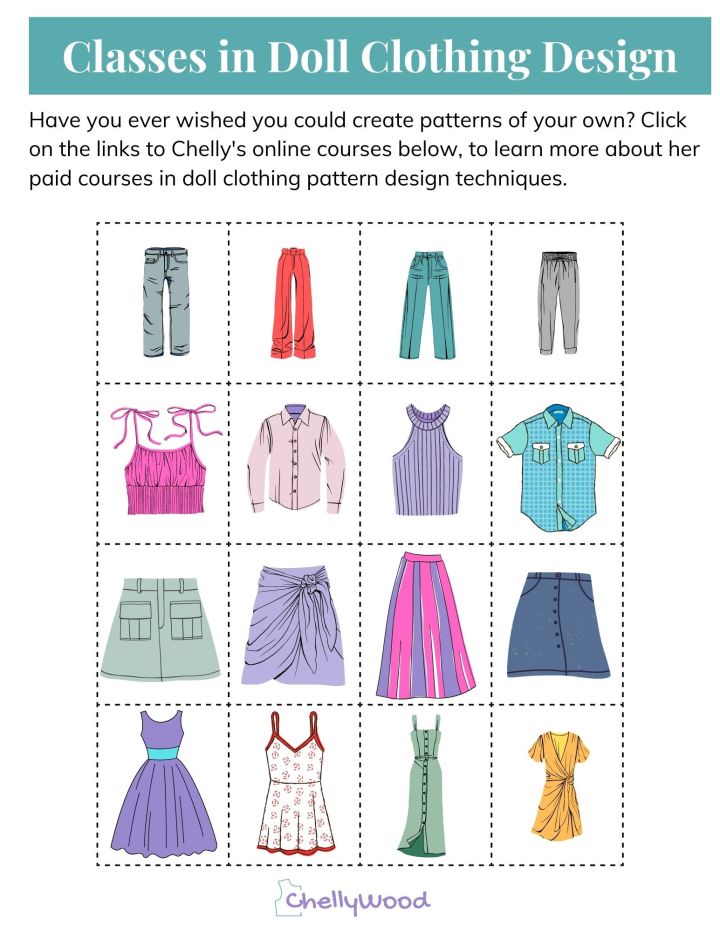
For any class on Creative Spark, you don’t have to follow a schedule. Just sign up when you’re ready.
It’s a one-time fee for the course, and there’s no specific time limit to finish your course. You can just take your time and learn at the pace that suits you. So go check out my paid courses on Creative Spark, using this link.
As always, feel free to pin, like, or tweet about my free patterns and tutorials.
To read more about my free sewing patterns and tutorials, please visit the “Helpful Tips” page.
Disclaimer/Credit/Affiliate Marketing Link:
*Please note: when you click on links to various merchants on this site and make a purchase, this can result in this site earning a commission. Affiliate programs and affiliations include Amazon, JoAnn Fabric, Etsy, and the eBay Partner Network. As an Amazon affiliate, I earn from qualifying purchases. To learn more about how my website uses affiliate marketing, please visit the website’s Privacy Policy page.
Chelly Wood and the ChellyWood.com website are not affiliated with any of the doll or toy companies mentioned in this blog post, but Chelly enjoys designing her doll clothes to fit a variety of dolls. To learn more about the doll companies mentioned in today’s post, please visit the doll or toy company’s website.
Hi. i “read” you every morning with my coffee. stuffed animals took me way back. i enjoy your style and all the extra information. keep it up (please).
joyce
i’m never sure if the closing period goes before or after the closing parenthesis. : )
What a nice comment. Thank you for making my day!
I love making tiny stuffed things out of felt. My mom made stuffed bears from old quilts. And sock monkeys! I have way more plans than time left in my whole life lol!!
“I have way more plans than time…” DITTO.
I would love the dog pattern -looks similiar to Snoopy- free? I make dolls & clothes, blankets and stuffed animals for disadvantaged children.
Hi Linda. I don’t know if you’ve seen my recent posts, but I’m without a computer right now. But I’ll add “plush Snoopy-like dog toy” to my request list. Thank you for leaving a request. I appreciate that people are still leaving comments and viewing my tutorial videos, even though I’m sort of “out of the office” while my computer is in for repairs!