

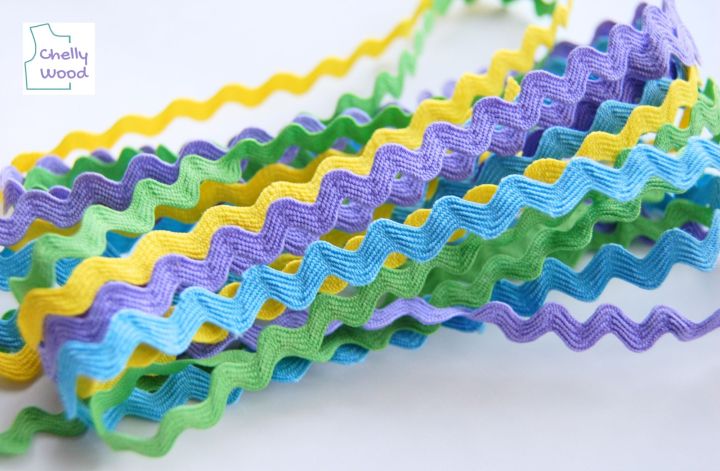
Do you see that green zigzag trim along the edges of my Lottie doll’s bolero jacket? That’s rickrack!
Webster’s dictionary describes rickrack trim as “a flat braid woven to form zigzags and used especially as trimming on clothing.”* But how does a person decide that a garment needs rickrack trim, and at what point in the garment’s creation does one attach it to the garment?
Before we look deeper into the topic of rickrack, I need to make my required disclaimer statement: As an Amazon affiliate, I earn from qualifying purchases. To learn more about how affiliate marketing works on my website, please go to the Privacy Policy page. Thank you!

The first question I posed in today’s blog post is this: How does a person decide that a garment needs rickrack trim?
If you look again at the bolero my Lottie doll is wearing, you’ll see that the braided rickrack I used to trim her little yellow jacket is a bright green color, like Lottie’s dress. The plain yellow jacket, I felt, would need a little something to help connect the green of the dress with the yellow of the bolero.
So that’s why I added rickrack. But just like choosing colors for a painting, this is more of a gut feeling than a formulaic method. In the comments, please let me know how you decide that a garment needs rickrack trim, so we can all learn form each other.
Do you use a system? And if so, what’s your system? Or do you just get a gut feeling like I do? Or maybe you just throw a little rickrack in the mix and hope it all turns out! — Let us know which one describes you best.

Secondly, I asked the question: At what point in the garment’s creation does one attach rickrack to the garment?
As you can see in the image above, I typically attach rickrack in the earliest stages of the garment’s creation, before I sew all the garment pieces together.
But sometimes this takes quite a bit of planning, reading ahead through the directions for piecing the garment together, in order to place the rickrack in the right locations. If the directions are complicated, I’ve been known to add the rickrack at a later stage from time to time, just to keep my brain from going numb!

Now it’s your turn. At what point in a garment’s creation do you tend to apply the rickrack? Do you only add rickrack if the pattern suggests it? Or do you sometimes add rickrack to a garment when the pattern doesn’t call for it at all?
And again, do you use a system that helps you make sure the rickrack looks like you want it to?
Finally, if you’d like to make a bolero like the one my Lottie doll is wearing in today’s blog post, just navigate over to this blog post. The pattern and tutorial videos are there, but you may need to make a few educated guesses about where and when to add the rickrack! 😉

If you enjoyed this blog post, and you’d like to see my videos, you might want to navigate over to my YouTube channel, ChellyWood1 to look through my playlists.
If you would like to make a donation to this free doll clothes pattern website, please click here. There’s also a “Donate” button in the main menu.
For anyone who would like to expand their dolls’ wardrobes, you should really check out my “How to Alter Doll Clothes Patterns” course and my “Design Your Own Doll Pants Patterns from Scratch” classes on the Creative Spark online learning platform. Here’s my bio page on their website, where you can learn more.
For any class on Creative Spark, you don’t have to follow a schedule. Just sign up when you’re ready.
It’s a one-time fee for the course, and there’s no specific time limit to finish your course. You can just take your time and learn at the pace that suits you. So go check out my paid courses on Creative Spark, using this link.
As always, feel free to pin, like, or tweet about my free patterns and tutorials.
To read more about my free sewing patterns and tutorials, please visit the “Helpful Tips” page.
Disclaimer/Credit/Affiliate Marketing Link:
Please note: when you click on links to various merchants on this site and make a purchase, this can result in this site earning a commission. Affiliate programs and affiliations include Amazon, Etsy, and the eBay Partner Network. As an Amazon affiliate, I earn from qualifying purchases. To learn more about how my website uses affiliate marketing, please visit the website’s Privacy Policy page.
Chelly Wood and the ChellyWood.com website are not affiliated with any of the doll or toy companies mentioned in this blog post, but Chelly enjoys designing her doll clothes to fit a variety of dolls. To learn more about the doll companies mentioned in today’s post, please visit the doll or toy company’s website.
*“Rickrack.” Merriam-Webster.com Dictionary, Merriam-Webster, https://www.merriam-webster.com/dictionary/rickrack. Accessed 27 Mar. 2025.