

I recently received an interesting “fan mail” question about pinking shears from a follower named Debora. She wanted to know my thoughts on pinking shears.
Debora asked, “Chelly, how do you use pinking shears, anyway? All over the Internet, you can find crafters who seem to get really excited about them and use them for everything. Especially among people who sew for dolls, because honestly, hemming a teeny-tiny neckline or armhole can be a huge challenge. So, I understand why people don’t want to do it. But when the crafter shows the result, you realize that sometimes the trick works well, and other times, not so well.”
Debora also wanted to know, “Is it worth buying them when you’re a beginner and want to keep things simple?”

Before we dive into this topic, I need to make my required disclaimer statement: As an Amazon affiliate, I earn from qualifying purchases. To learn more about how affiliate marketing works on my website, please go to the Privacy Policy page. Thank you!
This is a good question, but it probably won’t surprise you that I’ve touched on this topic, on my website, in the past. To find past articles I’ve written about pinking shears, you can click here.
One of the best uses of pinking shears is to prevent some element of fray in easy-to-fray fabrics. But as Debora mentioned in her email, when using an easy-to-fray type of fabric, the use of pinking shears is only going to cut back the fray a little bit. So why bother?

It’s possible to combine the use of pinking shears with a product called Fray Check, which when dabbed along the cut edge, will definitely prevent fray, even in the most fray-heavy fabrics. The downside to Fray Check is that it can discolor some fabrics. It also washes out, if you run your garment through the washing machine.
Debora also asked if pinking shears are a good tool for beginners. I don’t think pinking shears are a great tool for the beginners out there, especially if you’re sewing doll clothes. They’re much better for making people-sized clothes. Pinking shears are just too heavy and clunky to cut tiny doll clothes neatly.

I also think beginners tend to use their pinking shears incorrectly, cutting every little garment with them and using them to avoid learning how to do some tougher sewing techniques that one should really stitch properly.
So instead of pinking shears, I recommend that everyone who’s learning to sew doll clothes should have a pair of mini scissors, and here in the US, Fiskars is the best brand, in my humble opinion.

After reading Debora’s email, it sounds like people online are using pinking shears to avoid hemming, which is not advisable. Over time, your zigzag-cut hem will definitely start to fray. That’s just how fabric works, and some fabrics fray more easily than others, like satin for example. Cotton and corduroy are less likely to fray, but all fabrics will start to fray eventually, especially at the hands of children who dress and undress dolls frequently.
The best use of a pair of pinking shears, when making doll clothes, is to cut along those edges that are round. For example, you can use them to cut the area where the sleeve will join the bodice. This is done to avoid “clipping seams” with little mini-scissors because pinking shears will give it a pre-clipped effect.

It’s possible to use pinking shears along the bottom of a doll’s rounded skirt, but you should still hem it. In my humble opinion, it will look unfinished (and frankly, it looks a bit silly) if a person leaves the zigzag edge exposed at the bottom of a doll’s skirt. However you may get away with doing a single-fold hem instead of a double-fold hem, when you cut the hemline with pinking shears.
And once again, the whole point of using pinking shears is to give the pre-clipped effect on a rounded edge.
Here’s something to think about though: if the pattern is for a knee-length skirt and the pattern designer intended for there to be a double-fold hem (like I often do for my patterns), then you have to make a slight alteration, bringing up the original pattern length. Otherwise you won’t end up with a knee-length skirt; instead, you’ll end up with a hem that’s just below the knee.

I’ve purchased pre-cut doll clothes patterns that had been cut out by someone who was obsessed with their pinking shears. It was very frustrating! All the patterns in the envelope had the zigzag edge to them, and therefore had to be re-drawn and cut for proper use. UGH!
So I am aware that some people who sew doll clothes really do love their pinking shears, but frankly, I prefer to clip my seams after sewing them, rather than zigzag cutting tiny round corners for armholes and such. I find it more satisfying to use Fiskars Mini-stitchers, and I honestly think the use of mini scissors gives you more control of rounded corners, so the overall fit of the garment is more precise.

And that’s my opinion of pinking shears. I do own them, but they sit in a drawer more than they get used. If I made myself clothes more often, I would probably use them more often. But I’m notoriously negligent when it comes to making human-sized clothing!
Let’s hear from other readers. Do you use pinking shears when making doll clothes? And if so, how and when do you use your pinking shears?

If you enjoyed this blog post, and you’d like to see my videos, you might want to navigate over to my YouTube channel, ChellyWood1 to look through my playlists.
If you would like to make a donation to this free doll clothes pattern website, please click here. There’s also a “Donate” button in the main menu.
For anyone who would like to expand their dolls’ wardrobes, you should really check out my “How to Alter Doll Clothes Patterns” course and my “Design Your Own Doll Pants Patterns from Scratch” classes on the Creative Spark online learning platform. Here’s my bio page on their website, where you can learn more.
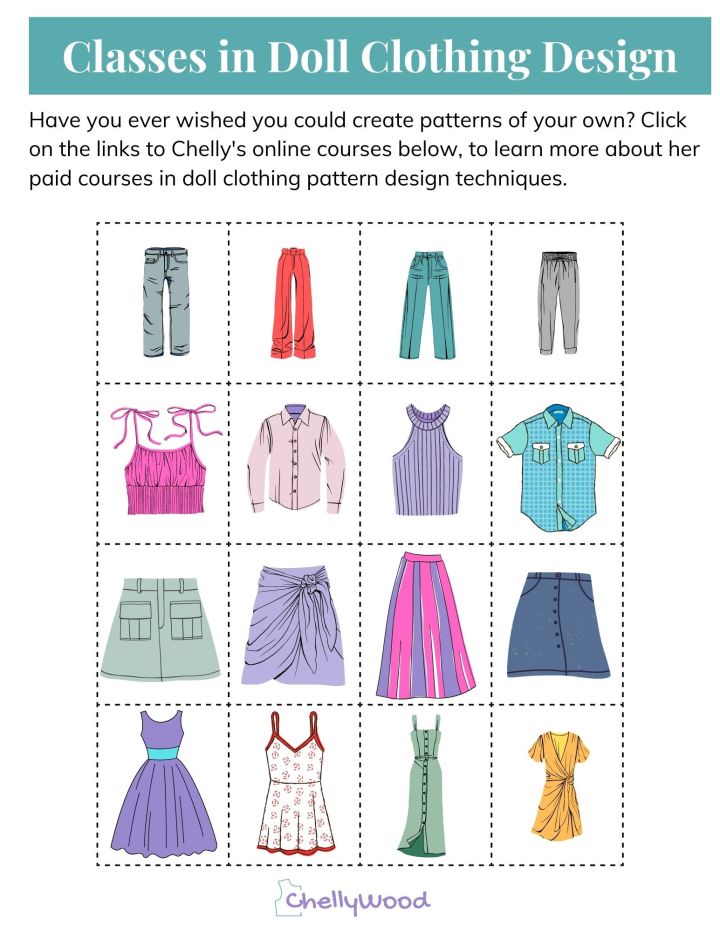
For any class on Creative Spark, you don’t have to follow a schedule. Just sign up when you’re ready.
It’s a one-time fee for the course, and there’s no specific time limit to finish your course. You can just take your time and learn at the pace that suits you. So go check out my paid courses on Creative Spark, using this link.
As always, feel free to pin, like, or tweet about my free patterns and tutorials.
To read more about my free sewing patterns and tutorials, please visit the “Helpful Tips” page.
Disclaimer/Credit/Affiliate Marketing Link:
*Please note: when you click on links to various merchants on this site and make a purchase, this can result in this site earning a commission. Affiliate programs and affiliations include Amazon, JoAnn Fabric, Etsy, and the eBay Partner Network. As an Amazon affiliate, I earn from qualifying purchases. To learn more about how my website uses affiliate marketing, please visit the website’s Privacy Policy page.
Chelly Wood and the ChellyWood.com website are not affiliated with any of the doll or toy companies mentioned in this blog post, but Chelly enjoys designing her doll clothes to fit a variety of dolls. To learn more about the doll companies mentioned in today’s post, please visit the doll or toy company’s website.
I’m just passing by to say hi!
Thanks for leaving a comment, and also thank you for the interview (question and answer session). Have a great day! 🙂