

I started my 7th grade year in the fall of 1979, and I distinctly remember owning an outfit that included a denim vest. It came with a pretty ruffled skirt made of tan denim, a white top made of lightweight cotton, and a tan denim vest with cream-colored topstitching. My aunt, Harriet, took me on a shopping spree just before school started, and she bought me this and several other items of clothing that I deeply treasured.
As a doll clothing designer, I have always paid attention to fashion, even when I didn’t have the money or means to buy what was in fashion, so I really, truly remember the ins and outs of vest fashion, as the years have gone by. In today’s blog post, let’s talk about vests…
Before I go on, I need to make my required disclaimer statement: As an Amazon affiliate, I earn from qualifying purchases. To learn more about how affiliate marketing works on my website, please go to the Privacy Policy page. Thank you!

The Simplicity 8281 Barbie pattern was a really fashionable pattern for its time, published by Simplicity in 1977, it included a wrap skirt, a sundress, a jogging suit, two styles of T-shirts (one with long sleeves and one with short sleeves — both raglan style), culottes (which we called “gauchos” where I lived), a tank top with wide leg pants, a layered long skirt, a cape, and a lovely wedding dress.
Capes weren’t popular at the time. I mean, everybody wanted one, wishing we could look like the woman guitarist from the band Heart, but nobody wore them to school. The wedding dress in the Simplicity 8281 Barbie pattern reminded me of the clothes worn on Little House on the Prairie, the TV series, and that was very much in style in the 1970’s!
It’s funny because when people today dress up in “70’s style” for a Halloween party or school event, they wear bell bottoms, John Lennon sunglasses, beads, a headband, and a brown vest. Besides the vest, I don’t remember anyone in my circle of friends dressing like that in the 1970’s. Nobody I knew wore long beads. You couldn’t buy a pair of sunglasses like John Lennon’s anywhere at that time — I remember looking for them at our shopping mall in Lewiston, Idaho, and no stores carried them!
So what did we wear in the 1970’s? Most of us wanted to look like Laura Ingalls from Little House! And yes, vests were popular. I do remember that.

So were gauchos (AKA culottes). In fact, I think I made myself an outfit like the one pictured in Simplicity 8281‘s view 6, including either knickers or gauchos to match a vest. By “knickers,” I don’t mean underpants; I mean gauchos that gather below the knee with a cuff that buttons at the side. I think it was from a pattern that offered both the knickers and the gauchos options.
But the vest was by far the easiest thing to make.
And for Barbie, that’s true as well. It really doesn’t take any effort at all to create a vest. Of course when I make a doll’s vest, I make it more complicated than it has to be! I line my Barbie vest, for better durability with heavy play.

That’s because I’ve been sewing doll clothes since I was a kid myself, and I’ve learned, over time, that children pull at any loose strings hanging from a garment you sew for their dolls.
I started high school in the fall of 1981, and I used the Simplicity 8281 sewing pattern to make over 60 items of clothing for dolls. I sold each item for a dollar a piece to my high school classmates — many of them had younger sisters — at Christmas time. One of the most popular items requested that year was the View 6 vest, tee, and gauchos set for Barbie. So yeah, I’ve made a few doll vests in my time.
And during that Christmas season in 1981, everybody wanted me to use denim.

But with time and practice, I’ve found that denim wasn’t the best material for Barbie clothes. Instead, a denim-look fabric made of lightweight cotton worked better. I could always do some red or gold topstitching, to make it look more like denim. And when you doubled the thickness of the cotton by lining the vest, the garment both looked and felt like it was made of lightweight denim.
And yes, to answer the question at the top of today’s blog post, I’m seeing denim vests returning to the fashion scene in 2025. In fact, the Love to Sew Podcast did an episode about vests recently, and for that podcast, each of the ladies made a vest. Helen made a denim vest, and I’ve seen it on Instagram. It’s to-DIE-for-cute! Here’s a link.
She made a second vest with a pieced sawtooth star (quilt style) sewn into the back panels of her vest. This style reminds me a little of the quilted vests that came into fashion in the 1990’s. So interestingly, vest fashion in the 2020’s seems to be broader in scope than vest fashions of the past.

In the ’70’s, denim vests were all the rage. In the 1980’s I remember both men and women wearing western style vests. In the 1990’s, men only wore vests for formal occasions like fancy dinners and weddings, while women wore quilted vests for the holidays — vests that were quilted or embroidered with snowmen at Christmas or pumpkins in the fall. That’s how I remember it.
When my husband and I got married, he wore a very expensive cowboy-style vest, and I remember young men wearing similar vests for prom back then. My husband and I attended a fancy dinner in the late ’90’s where I sat across the table from a man who wore a beautifully beaded and fringed vest. The beads on his vest formed a horse’s head. It was so well crafted!

Of course, I live in Idaho, where western clothing never goes out of style, so maybe fashion norms were very different in the cities back east in the 1990’s. And that big-city flair traveled out west, hitting Idaho around the time my kids came on the scene.
It seems like vests for both men and women have been out-of-style since the early 2000’s. In fact, anything that looked home-made, crafty, or quilty seemed to take a dive between the early 2000’s and 2019. Do any of you remember that trend?
I suppose people staying home during Covid came to realize that crafting was not only fun, but the re-use of fabrics and craft supplies could be good for the environment. And I’m happy to see this open-minded change.

Now I’d like to know your thoughts on vests. Did you own one in the past? Have you ever made one? And what eras do you remember as a time period when vests were popular? Are you seeing them in your home town? Are people in your friendship and family circles wearing them?
I’m also curious if other people my age and older (I’m 58) remember the 1970’s the same way I do? Have people’s incorrect perceptions of 1970’s fashion history overshadowed the actual fashions that you remember? Or am I unique because I grew up in the west, where western fashion has always been popular?
Please leave a comment!

Most of the commercial patterns I display and talk about here on ChellyWood.com are also available for sale on eBay. However, if you’ve never purchased a pattern on eBay before, it’s a good idea to read the article I wrote called, “Tips for Buying Used Doll Clothes Patterns on eBay.” It will save you time, money, and will likely prevent buyer’s remorse.
And by the way, if you use the links I’ve provided to make your eBay purchase, my website will receive a small commission, which helps fund the ChellyWood.com site, so I can continue to provide you with all the free patterns and tutorial videos offered here.
For more of my free tutorials, be sure to subscribe to my YouTube channel, ChellyWood1.
If you would like to make a donation to this free doll clothes pattern website, please click here. There’s also a “Donate” button in the main menu.
For anyone who would like to expand their dolls’ wardrobes, you should really check out my “How to Alter Doll Clothes Patterns” course and my “Design Your Own Doll Pants Patterns from Scratch” classes on the C&T Publishing website. Here’s my bio page on their site, where you can learn more.
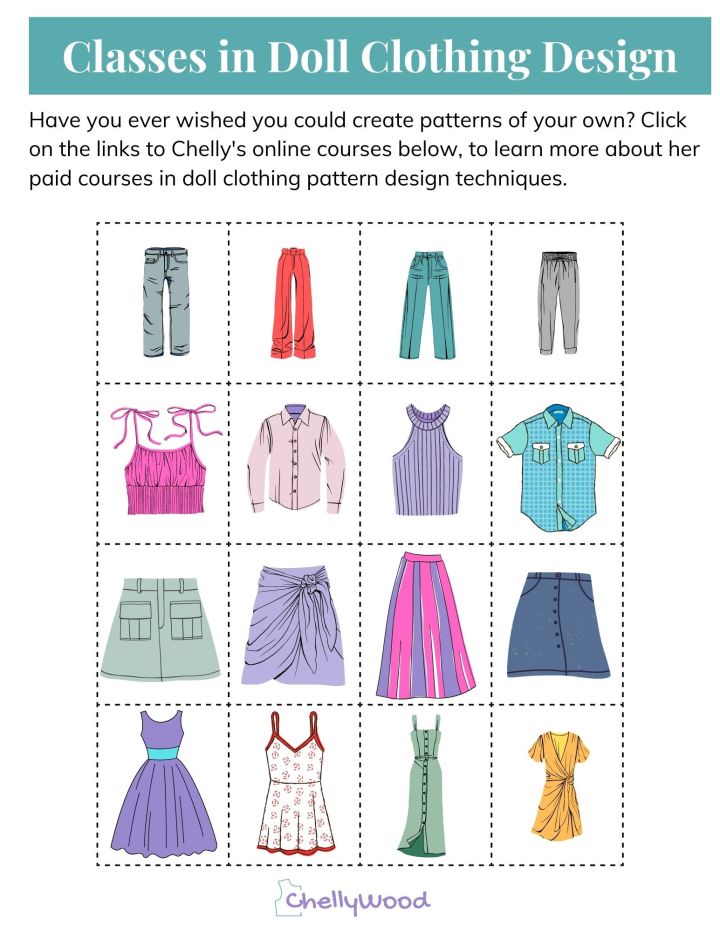
For any class on the C&T Publishing website, you don’t have to follow a schedule. Just sign up when you’re ready.
It’s a one-time fee for the course, and there’s no specific time limit to finish your course. You can just take your time and learn at the pace that suits you. So go check out my paid courses on the C&T Pub site, using this link.
As always, feel free to share my images on social media to help spread the word about my free patterns.
To read more about my free sewing patterns and tutorials, please visit the “Helpful Tips” page.
Disclaimer/Credit/Affiliate Marketing Link:
*Please note: when you click on links to various merchants on the ChellyWood.com site and make a purchase, this can result in this site earning a commission. Affiliate programs and affiliations include Amazon, Etsy, and the eBay Partner Network. As an Amazon affiliate, I earn from qualifying purchases. To learn more about how my website uses affiliate marketing, please visit the website’s Privacy Policy page.
Chelly Wood and the ChellyWood.com website are not affiliated with the pattern company or companies mentioned in this blog post, but Chelly finds inspiration in the doll clothes designed by these pattern companies. To purchase patterns from Simplicity, McCall’s, Butterick, Vogue, or other pattern companies shown and discussed in this blog post, please click on the links provided here. These links below the “Disclaimer” section do not help raise money for this free pattern website; they are only offered to give credit to the company that made these patterns.