

As most of my regular followers know, when it comes to making clothes for dolls, I really like to sew by hand. If I’m using a slippery or curly fabric, like satin or jersey, I definitely prefer sewing by hand.
For today’s project — a raglan-sleeved Barbie shirt–I sewed it from start to finish, using a number of different hand stitches. And this blog post will tell you which hand stitches I used for the various parts of the shirt, and why I chose each of those different hand stitches for that particular part of the garment.
Before I go on, I need to make my required disclaimer statement: As an Amazon affiliate, I earn from qualifying purchases. To learn more about how affiliate marketing works on my website, please go to the Privacy Policy page. Thank you!

Last Monday I re-posted the tale of how I had been obsessing about making the raglan sleeved, red-and-white striped top from View 6 in the Simplicity 8281 sewing pattern for Barbie. Well, today I’m coming back to that project, to announce that I’ve finished sewing that particular shirt.
It can be very satisfying to sew by hand (as many of you know), but with lightweight jersey fabric, the edges of the fabric naturally want to curl once you’ve cut out the garment pieces. This can make it hard to locate all of the notches you’ve cut into the fabric, but when you sew by hand, you give yourself enough time to slow down and pay attention to each notch and chalk mark on every garment piece.
Striped jersey fabric also requires that you think about which directions your stripes will be running, once the garment is finished. Not every doll clothes pattern is marked with grainlines, but thankfully Simplicity 8281 does have grainlines.

For anyone who’s new to sewing, the grainline is a double-headed arrow that sometimes says “straight grain of fabric” alongside it. Sometimes, though, it’s just a double-headed arrow with no words, which assumes you already know what that arrow is for — namely, grainlines.
Now you might wonder, If that double-headed arrow is supposed to follow the lines of the stripes, Chelly is pinning her pattern all wrong! However I wanted my stripes to run vertically, along the body of the doll and the arms of the doll, so when I cut out my sleeves, I aligned my grainline arrows perpendicular to the stripes.
So before you cut out your raglan sleeved shirt, it’s a good idea to a.) pay attention to grainlines and b.) consider what you want the final product to look like, especially where the sleeves will meet the bodice pieces.
It may be challenging to understand where two pieces of fabric will meet. In a raglan-sleeved shirt, the sleeve meets the shirt’s front at an angle from the neck to the underarm area. On my cuts of fabric, this seam is marked with notches. In the image below, notches are marked with arrows.

The red arrows point to single triangle-shaped notches. These indicate the front of the garment. The black arrows point to double notches, which you cut out more like a trapezoid for the Simplicity 8281 pattern. And in all honesty, even when a double notch forms two triangles, I have a tendency to cut it out like a trapezoid as well. That’s just me though. Double-triangle or trapezoidal notches indicate the back of the pattern.
The numbers in that image above show the steps I would take to create this garment, sewing piece one (the left back) to piece two (a sleeve) at its matching trapezoidal notch; then sewing piece two (the same sleeve) to piece three (the shirt front) at the single triangle notch, and so on.
To really get a feel for this step-by-step process, have a look at the video below, which shows how to sew one of the raglan sleeved shirts that I’ve designed for a modern Skipper or Disney Princess 10 inch doll. The free pattern for making this shirt can be found at this link.
Now let’s talk about the types of hand stitching that I used when I sewed this Simplicity 8281 View 6 shirt. Once I finished sewing each of the pieces at their angled notch areas, the end result looked sort of like half of a flower with petals sticking out. (To see what I mean, go to timestamp 2:40 in the video above.)
Once you reach this half-a-flower stage, it’s a good time to stitch the collar. For the Simplicity 8281 View 6 shirt pattern, I decided that I would stick to the single-fold hem that was recommended for this shirt, in the instructions. For a single-fold hem along the collar, you really need to use a simple straight stitch after clipping the collar.

Why not use a whipstitch for the collar? It’s not going to be as sturdy as a straight stitch in this instance. Since raw fabric will hang down from the bottom of the folded fabric (inside the shirt), a whipstitch doesn’t quite catch and hold the fabric as well as a straight stitch would.
With a whipstitch, you would have more curl and fray. With a straight stitch (shown on the collar in the image above), each clip has a stitch holding that clipped part of the fabric in place, preventing excess curl and fray.
If you’re not sure what a straight stitch is, this video should help… Sorry for the poor quality of this video. It’s almost a ten-year-old video, so I really need to re-do and update it!
Once the collar of my shirt was done, it was time to sew the darts. For these, I used a backstitch. I also used a backstitch for the side seams. But before sewing the side seams, I needed to get the ends of each sleeve hemmed.
Now one trick I use to make sure a doll’s garment is going to fit, is to try it on the doll (or as you can see in the image below) to measure the pattern pieces against the doll, so I can determine whether or not alterations will be needed.
If you really don’t know what I mean by “alterations,” please scroll down past the image of a needle and cross stitches and look for a graphic titled, “Classes in Doll Clothing Design,” as I do teach online classes in doll clothes pattern alterations.

Simplicity 8281 is actually designed to fit both 11 inch and 12 inch fashion dolls, so when I measured my vintage Barbie’s arm next to the sleeve pattern, I discovered that the sleeve was going to be a little long for her if I cut the pattern at its longest length. Normally I would fold the pattern back a bit (just below where the hem at the doll’s wrist would be) before cutting out my sleeves.
But after I had finished hemming the neckline with a straight stitch, I tried the unfinished garment on the doll, only to discover that the sleeve was still a bit too long for Barbie. (I may have decided not to alter it and see how it goes.) So I ended up doing a double-fold hem at the bottom of each sleeve, even though that’s not what the directions suggested.
For a double-fold hem, I always use a whipstitch when sewing by hand. I know other people use a ladder stitch to hide a hem, but doll clothes are so tiny, I’ve found it helpful to just go with a whipstitch. (I’m also not very good at a ladder stitch, to be perfectly honest.)
Then I used a backstitch to sew the side seams. When I say “side seams,” that includes the seam that connects the two sides of a single sleeve. (Here’s a link to my backstitch video, if you need to review how to do a backstitch.)
When I put the garment on the doll again, I discovered that the back closure had a huge overlap, making the whole garment too loose on Barbie. Again, I think this is probably due to the fact that the Simplicity 8281 pattern is made to fit Barbie plus the 12 inch Farrah Fawcett and Cher dolls, which were made by Mego in the 1970’s.
So in the back closure area, along with the bottom hem, I did a double-fold hem with a whipstitch. The diagram below shows which stitch I sewed in each seam location for this long-sleeved shirt.

This is a well made garment, but as a doll clothing designer myself, I would have designed this shirt differently, especially at the collar. I would have either lined it or created a separate garment piece to form a fold-over collar that a person could whipstitch (like the one on my Skipper raglan-sleeved tee). Vain though it sounds, I just like my own design a little better.
Even with some of the challenging aspects to this project though, I still feel like this red and white striped tee shirt turned out very nice. Since it’s made to fit both Barbie and the bigger Mego dolls, the overall fit of the shirt is somewhat loose, even with the alterations I’ve made. And when I tried it on a modern Barbie, it looked waaay too big.
I suppose that makes sense, since it wasn’t designed for her.
But it fits a vintage Barbie nicely.


Most of the commercial patterns I display and talk about here on ChellyWood.com are also available for sale on eBay. However, if you’ve never purchased a pattern on eBay before, it’s a good idea to read the article I wrote called, “Tips for Buying Used Doll Clothes Patterns on eBay.” It will save you time, money, and will likely prevent buyer’s remorse.
And by the way, if you use the links I’ve provided to make your eBay purchase, my website will receive a small commission, which helps fund the ChellyWood.com site, so I can continue to provide you with all the free patterns and tutorial videos offered here.
For more of my free tutorials, be sure to subscribe to my YouTube channel, ChellyWood1.
If you would like to make a donation to this free doll clothes pattern website, please click here. There’s also a “Donate” button in the main menu.
For anyone who would like to expand their dolls’ wardrobes, you should really check out my “How to Alter Doll Clothes Patterns” course and my “Design Your Own Doll Pants Patterns from Scratch” classes on the C&T Publishing website. Here’s my bio page on their site, where you can learn more.
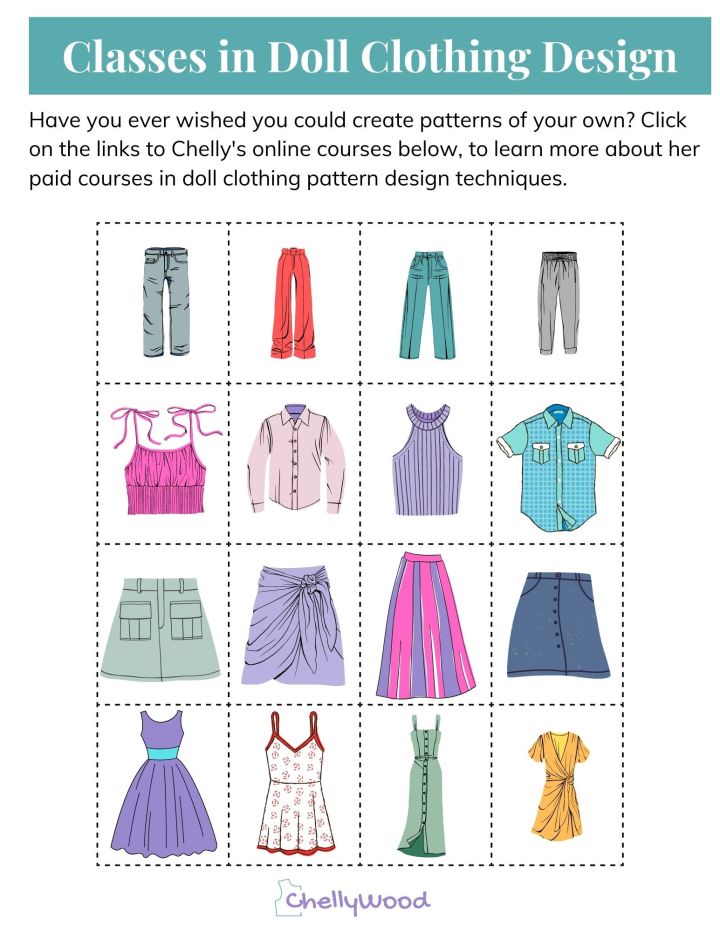
For any class on the C&T Publishing website, you don’t have to follow a schedule. Just sign up when you’re ready.
It’s a one-time fee for the course, and there’s no specific time limit to finish your course. You can just take your time and learn at the pace that suits you. So go check out my paid courses on the C&T Pub site, using this link.
As always, feel free to share my images on social media to help spread the word about my free patterns.
To read more about my free sewing patterns and tutorials, please visit the “Helpful Tips” page.
Disclaimer/Credit/Affiliate Marketing Link:
*Please note: when you click on links to various merchants on the ChellyWood.com site and make a purchase, this can result in this site earning a commission. Affiliate programs and affiliations include Amazon, Etsy, and the eBay Partner Network. As an Amazon affiliate, I earn from qualifying purchases. To learn more about how my website uses affiliate marketing, please visit the website’s Privacy Policy page.
Chelly Wood and the ChellyWood.com website are not affiliated with the pattern company or companies mentioned in this blog post, but Chelly finds inspiration in the doll clothes designed by these pattern companies. To purchase patterns from Simplicity, McCall’s, Butterick, Vogue, or other pattern companies shown and discussed in this blog post, please click on the links provided here. These links below the “Disclaimer” section do not help raise money for this free pattern website; they are only offered to give credit to the company that made these patterns.