

I’ve been working with the vintage Ken doll clothing pattern, Sew Easy Advance 2899, and this time, specifically, I’ve been sewing the jacket from the View 1 image on the envelope.
Like many Ken-sized coat patterns, this dinner jacket comes with a facing piece, which must be attached around the front inside section of the jacket, to help form the lapels. When I saw that this project came with a facing, I knew there’d be trouble!
*Please note: when you click on links to various merchants on this site and make a purchase, this can result in this site earning a commission. Affiliate programs and affiliations include Amazon, Etsy, and the eBay Partner Network. As an Amazon affiliate, I earn from qualifying purchases. To learn more about how my website uses affiliate marketing, please visit the website’s Privacy Policy page.

What you see in the images above was my first attempt at sewing the jacket’s facing.
After sewing the two pieces together (figure 1), hemming the inner edge, and following seam allowances exactly, I placed the facing against the outer edge of the jacket (figure 2), only to discover that it wasn’t going to fit.
In figure 3, you can see a close-up of the photo shown in figure 2. As I placed the facing against the edge it was supposed to be stitched to, I realized that the lapel area (shown close-up in figure 3) did not match the edge of the facing properly.

It’s not just the Advance 2899 pattern‘s facing that doesn’t work; I’ve encountered this problem when making Barbie clothes as well. It’s tricky, when you’re working with such tiny garment pieces, to cut out all the pieces so they fit together properly.
So in round 2, I altered the facing’s pattern to give me a lot more seam allowance where the two facing pieces join each other. In Figure 4 above, you can see that the re-cut facing has more than a quarter of an inch of additional fabric to work with, along that joining seam.
However, Figure 5 shows that once I’d stitch this new facing to the jacket, the extra fabric wanted to buckle. So how did I fix this problem?

I stitched the facing down with a top stitch, of course. In the top image, the zoomed in photo shows my stitch line right along the edge of that collar.
If you look closely at the front of Ken’s jacket, you’ll see that I added top stitching to not just the collar, but the lapel and pockets too. With that checkerboard fabric, it’s sort of hard to see my stitches, but I wasn’t trying to hide them or anything.
And honestly, if I were to make this jacket again, I wouldn’t use that black and white checkered fabric.

I mean, yeah, it looks manly on Ken, and it has a nostalgic, retro-feel to it.
But doesn’t he sort of look like the flag at the end of an Indy 500 race?

It’s okay, Ken. Keep rockin’ that look with a subtle smile on your face.
It’s a very nice jacket pattern from Advance 2899, but if I was to make it over again, I’d just give it a full lining instead of trying to make that awful facing piece fit inside there properly.
I mean… it fits. So that’s good.

Most of the commercial patterns I display and talk about here on ChellyWood.com are also available for sale on eBay. However, if you’ve never purchased a pattern on eBay before, it’s a good idea to read the article I wrote called, “Tips for Buying Used Doll Clothes Patterns on eBay.” It will save you time, money, and will likely prevent buyer’s remorse.
And by the way, if you use the links I’ve provided to make your eBay purchase, this website will receive a small commission, which helps fund the ChellyWood.com website, so I can continue to provide you with all the free patterns and tutorial videos offered here.
For more of my free tutorials, be sure to subscribe to my YouTube channel, ChellyWood1.
If you would like to make a donation to this free doll clothes pattern website, please click here. There’s also a “Donate” button in the main menu.
For anyone who would like to expand their dolls’ wardrobes, you should really check out my “How to Alter Doll Clothes Patterns” course and my “Design Your Own Doll Pants Patterns from Scratch” classes on the Creative Spark online learning platform. Here’s my bio page on their website, where you can learn more.
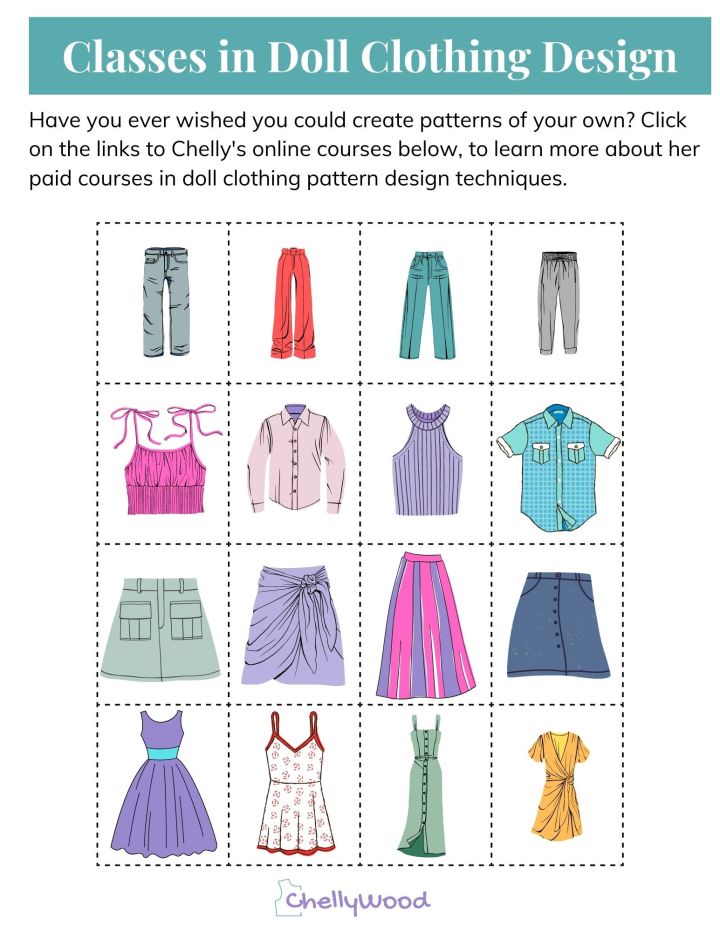
For any class on Creative Spark, you don’t have to follow a schedule. Just sign up when you’re ready.
It’s a one-time fee for the course, and there’s no specific time limit to finish your course. You can just take your time and learn at the pace that suits you. So go check out my paid courses on Creative Spark, using this link.
As always, feel free to pin, like, or tweet about my free patterns and tutorials.
To read more about my free sewing patterns and tutorials, please visit the “Helpful Tips” page.
Disclaimer/Credit/Affiliate Marketing Link:
*Please note: when you click on links to various merchants on this site and make a purchase, this can result in this site earning a commission. Affiliate programs and affiliations include Amazon, Etsy, and the eBay Partner Network. As an Amazon affiliate, I earn from qualifying purchases. To learn more about how my website uses affiliate marketing, please visit the website’s Privacy Policy page.
Chelly Wood and the ChellyWood.com website are not affiliated with the pattern company or companies mentioned in this blog post, but Chelly finds inspiration in the doll clothes designed by these pattern companies. To purchase patterns from Simplicity, McCall’s, Butterick, Vogue, or other pattern companies shown and discussed in this blog post, please click on the links provided here. These links below the “Disclaimer” section do not help raise money for this free pattern website; they are only offered to give credit to the company that made these patterns.