

Last week I gave you a few tips and pointers on sewing a collar for Ken’s View 2 long-sleeved shirt, in the Advance 2899 doll clothes sewing pattern. This is a vintage sewing pattern from 1962, and I’m really enjoying sewing with it!
This week, I’m going to talk about how to sew on a patch pocket, like the pocket you see on my Ken doll’s left breast, on the white shirt he’s wearing, in the image above. This is the same shirt as the one we saw last week (the View 2 shirt with a collar and cuffs).
*Please note: when you click on links to various merchants on this site and make a purchase, this can result in this site earning a commission. Affiliate programs and affiliations include Amazon, Etsy, and the eBay Partner Network. As an Amazon affiliate, I earn from qualifying purchases. To learn more about how my website uses affiliate marketing, please visit the website’s Privacy Policy page.

In the image above, you can see the instructions from the original Advance 2899 doll clothes pattern. It suggests double-folding and just pressing the top part of the pocket without ever stitching that top part of the pocket.
However, if you follow this blog regularly, it probably won’t surprise you that I didn’t follow the directions as they are written. I’m known for making a lot of alterations!
In the earliest stage — when cutting the pattern out — I almost didn’t use the pattern they gave me because I could see that this pattern wasn’t big enough to provide a lining for the pocket, which is typically my preference. (To see how I design my own pockets with a simple lining, please visit this page.)

In the image above, Figure 1 shows how most people do a hem stitch to the pressed area at the top of the pocket. Figure 2 is how my own pockets are designed, having a fold at the top (where you fold the pocket in half to create a lining).
So for this Advance 2899 View 2 shirt pocket, I stuck with the original pattern, but instead of only pressing it before sewing around it, I stitched the top fold down first; that’s represented by the green stitches in Figure 4. Then I stitched the other folded flaps down, which is represented by the black stitches in Figure 4.
And finally, once all my folded-in sides had been stitched in place, I whipstitched around the two sides and the bottom of the pocket, attaching it to the shirt as a final step, which is represented in Figure 4 by the pink or red stitch marks.

Also, the Advance 2899 pattern‘s instructions suggest applying the pocket before stitching the shirt front to the yoke and back, but I actually added my pocket after I had attached the shirt front to the shirt’s yoke and back.
Once it was largely put together (but before I sewed the side seams), I also pinned my shirt to the doll (see image above) to make sure I really had the pocket on straight. If you wait until you’ve finished the shirt’s side seams, it’s a lot trickier to unpick/seam-rip that patch pocket and pull it off of there to re-position it.
I did all of my stitches using a matching white thread, of course, so they’re more or less invisible. That’s why you can’t see my stitches at all on the pocket itself, as a final product.

Even though there was a lot of stitching involved, I think it really looks nice on the doll, and I think the extra stitches I gave to the folds will prevent fraying over time with heavy play and/or dressing-and-undressing.
If I ever make this shirt again, though, I think I will cut the Advance 2899 shirt pocket pattern on the fold, to create that cleaner, less stitch-heavy patch pocket that I typically create for my own doll clothes patterns.

Most of the commercial patterns I display and talk about here on ChellyWood.com are also available for sale on eBay. However, if you’ve never purchased a pattern on eBay before, it’s a good idea to read the article I wrote called, “Tips for Buying Used Doll Clothes Patterns on eBay.” It will save you time, money, and will likely prevent buyer’s remorse.
And by the way, if you use the links I’ve provided to make your eBay purchase, this website will receive a small commission, which helps fund the ChellyWood.com website, so I can continue to provide you with all the free patterns and tutorial videos offered here.
For more of my free tutorials, be sure to subscribe to my YouTube channel, ChellyWood1.
If you would like to make a donation to this free doll clothes pattern website, please click here. There’s also a “Donate” button in the main menu.
For anyone who would like to expand their dolls’ wardrobes, you should really check out my “How to Alter Doll Clothes Patterns” course and my “Design Your Own Doll Pants Patterns from Scratch” classes on the Creative Spark online learning platform. Here’s my bio page on their website, where you can learn more.
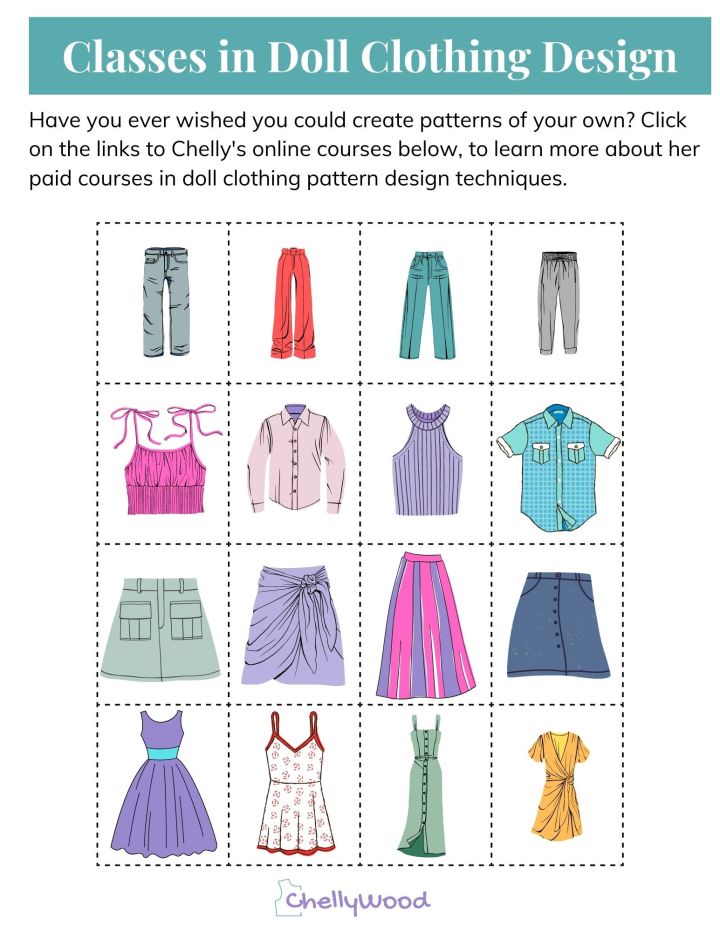
For any class on Creative Spark, you don’t have to follow a schedule. Just sign up when you’re ready.
It’s a one-time fee for the course, and there’s no specific time limit to finish your course. You can just take your time and learn at the pace that suits you. So go check out my paid courses on Creative Spark, using this link.
As always, feel free to pin, like, or tweet about my free patterns and tutorials.
To read more about my free sewing patterns and tutorials, please visit the “Helpful Tips” page.
Disclaimer/Credit/Affiliate Marketing Link:
*Please note: when you click on links to various merchants on this site and make a purchase, this can result in this site earning a commission. Affiliate programs and affiliations include Amazon, Etsy, and the eBay Partner Network. As an Amazon affiliate, I earn from qualifying purchases. To learn more about how my website uses affiliate marketing, please visit the website’s Privacy Policy page.
Chelly Wood and the ChellyWood.com website are not affiliated with the pattern company or companies mentioned in this blog post, but Chelly finds inspiration in the doll clothes designed by these pattern companies. To purchase patterns from Simplicity, McCall’s, Butterick, Vogue, or other pattern companies shown and discussed in this blog post, please click on the links provided here. These links below the “Disclaimer” section do not help raise money for this free pattern website; they are only offered to give credit to the company that made these patterns.