

Recently I sewed the collared shirt shown in View 2 of this vintage 1962 Advance 2899 sewing pattern for Ken dolls. While I was working on this, I got a message from one of my followers, asking if there’s a trick to sewing Ken’s collars so they will lay flat.
And yes, there are a couple of tricks. Today’s blog post will address them.
*Please note: when you click on links to various merchants on this site and make a purchase, this can result in this site earning a commission. Affiliate programs and affiliations include Amazon, Etsy, and the eBay Partner Network. As an Amazon affiliate, I earn from qualifying purchases. To learn more about how my website uses affiliate marketing, please visit the website’s Privacy Policy page.

When you see a human man wearing a collared shirt that looks crisp and is slightly “tented” against the shirt (as in the image above), he’s probably using something called “collar stays.” A sewist can create a little pocket on the underside of the collar to pop removable collar stays into, or they can sew the collar stays directly into the collar itself.
However, creating something like this for a Ken doll is next to impossible, unless you plan to sew with tweezers!
Without doing something to your Ken doll‘s collar, it will inevitably pop out, giving Ken a look that’s best described as James Dean-esque.

So what I prefer to do is simple enough: I stitch the collar to the shirt itself.
In the image below, you can see that on the left side (Ken’s right), I’ve stitched the collar to the shirt with just a few stitches around the tip of the collar itself.
On the right side, though (Ken’s left), I have not yet tacked the collar down at all, so it’s sort of flying around, waiting for an opportunity to pop out.

Whenever I use this technique, I typically do not stitch down the back of the collar. This allows the collar to look more natural.
In fact, I recommend that you tack the collar down with as few stitches as possible, whether you’re sewing the collared shirt in the Advance 2899 packet or any other collared shirt for dolls.
More stitches will make it pucker.

And it’s okay if it puckers when it’s laying against a table or cutting mat, as shown above.
The key is to make sure it looks natural when it’s ON the doll.

And in the image above, my vintage 1960 Ken‘s collar lays nice and flat against the shirt, after I’ve stitched it to the shirt along the pointed areas of each collar. That’s the look I’m going for.
The second method is to use bias tape rather than the fabric of the shirt, when sewing your collar. And once again, I recommend stitching it directly to the shirt.
In my tutorial for my yellow zipper-back dress for the tiny Disney Princess Elsa doll, I show you how this can be done to great effect.

Some important things to remember when sewing a bias tape collar directly to the shirt (or in Elsa’s case, the bodice) include the following:
- Choose a bias tape that coordinates nicely with your fabric or matches it exactly
- Use thread that also matches the bias tape
- Keep your stitches tiny
- Choose bias tape that’s already folded, for a crisp, starched look to your collar
- Make sure the size of bias tape that you choose works for the size of doll you’re sewing for
And that’s really all I have to say about sewing a collared shirt for Ken using Advance 2899 (or any other collared shirt pattern for that matter). But if you have any further questions about my techniques, or if you’d like to offer suggestions of your own, feel free to leave your thoughts in the comments section!

Most of the commercial patterns I display and talk about here on ChellyWood.com are also available for sale on eBay. However, if you’ve never purchased a pattern on eBay before, it’s a good idea to read the article I wrote called, “Tips for Buying Used Doll Clothes Patterns on eBay.” It will save you time, money, and will likely prevent buyer’s remorse.
And by the way, if you use the links I’ve provided to make your eBay purchase, this website will receive a small commission, which helps fund the ChellyWood.com website, so I can continue to provide you with all the free patterns and tutorial videos offered here.
For more of my free tutorials, be sure to subscribe to my YouTube channel, ChellyWood1.
If you would like to make a donation to this free doll clothes pattern website, please click here. There’s also a “Donate” button in the main menu.
For anyone who would like to expand their dolls’ wardrobes, you should really check out my “How to Alter Doll Clothes Patterns” course and my “Design Your Own Doll Pants Patterns from Scratch” classes on the Creative Spark online learning platform. Here’s my bio page on their website, where you can learn more.
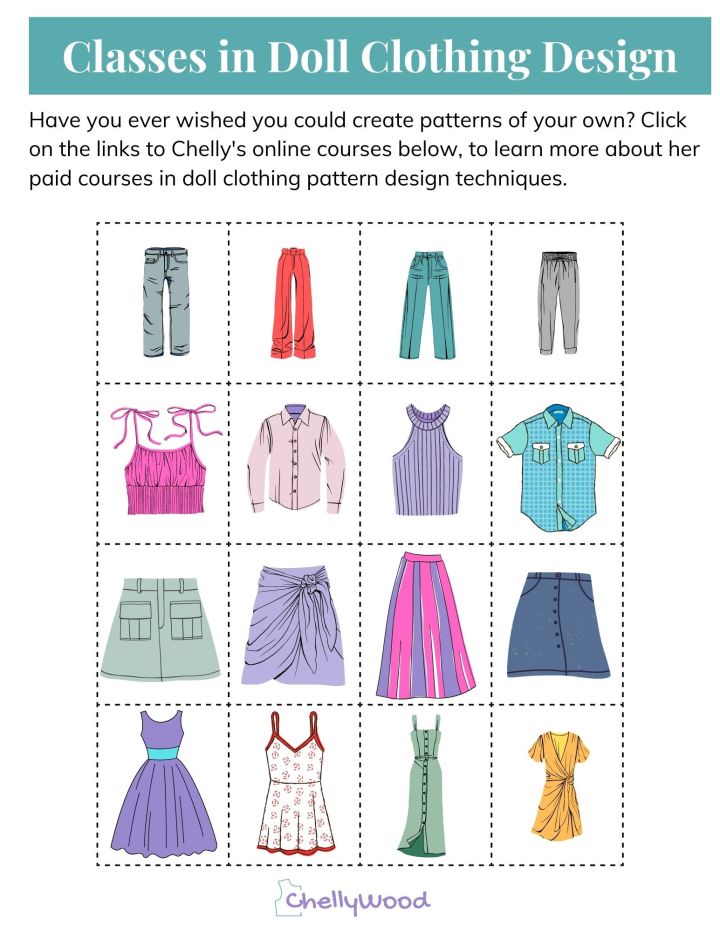
For any class on Creative Spark, you don’t have to follow a schedule. Just sign up when you’re ready.
It’s a one-time fee for the course, and there’s no specific time limit to finish your course. You can just take your time and learn at the pace that suits you. So go check out my paid courses on Creative Spark, using this link.
As always, feel free to pin, like, or tweet about my free patterns and tutorials.
To read more about my free sewing patterns and tutorials, please visit the “Helpful Tips” page.
Disclaimer/Credit/Affiliate Marketing Link:
*Please note: when you click on links to various merchants on this site and make a purchase, this can result in this site earning a commission. Affiliate programs and affiliations include Amazon, Etsy, and the eBay Partner Network. As an Amazon affiliate, I earn from qualifying purchases. To learn more about how my website uses affiliate marketing, please visit the website’s Privacy Policy page.
Chelly Wood and the ChellyWood.com website are not affiliated with the pattern company or companies mentioned in this blog post, but Chelly finds inspiration in the doll clothes designed by these pattern companies. To purchase patterns from Simplicity, McCall’s, Butterick, Vogue, or other pattern companies shown and discussed in this blog post, please click on the links provided here. These links below the “Disclaimer” section do not help raise money for this free pattern website; they are only offered to give credit to the company that made these patterns.