

The garment trim you see above was part of a box of old lace and garment trims that my mother-in-law gave me. I suspect that this little piece of trim had been removed from a garment that was no longer useable because the trim was partially gathered and had little threads hanging from the area I’ve labeled as “fraying gather edge.”
It was also yellowing with age when I received it. In spite of its many issues, I had faith that I could one day work with this piece of recycled garment trim, and in fact, as you’ll see in today’s blog post, I have!
*Please note: when you click on links to various merchants on this site and make a purchase, this can result in this site earning a commission. Affiliate programs and affiliations include Amazon, Etsy, and the eBay Partner Network. As an Amazon affiliate, I earn from qualifying purchases. To learn more about how my website uses affiliate marketing, please visit the website’s Privacy Policy page.

The first thing I did before I began working with this piece of recycled trim was to clean it. I put it in a lingerie bag with some other yellow-with-age bits and pieces from the same box of hand-me-down lace and trims.
While washing it brought back its almost pristine whiteness, it also caused the fraying to become worse, so I cut away all frayed areas from the trim.
Next I decided on a pattern it would work well with, and the obvious choice was the crop top from my Ideal Tammy Simplicity 4883 sewing pattern.

As you can see in the image above, there was some concern that I wouldn’t have enough left over when the frayed bits were trimmed off.
However, once gathered, I decided each piece did, in fact, fit the garment’s larger front bodice and smaller back pieces.
The instructions in the Simplicity 4883 envelope suggest making the garment without a lining, but I’d already done this for an earlier pink flannel pajama set (using the same View 4 patterns). So in spite of the instructions, I went ahead and gave my little crop top a simple white lining.

Once I had gathered all trim segments, I had to sandwich the trim in-between the garment’s lining and the green-and-white striped outer fabric, of course.
Now, I could have sewn the whole bodice together and attached the trim on the “wrong” side of the bodice. In that case, I wouldn’t have needed to cut the trim into three segments, sewing each one separately.
However, I wanted my garment to look pretty on the underside as well as the outside. There’s a little more work involved in doing it this way, but I think hiding the gathered edge between the two layers of the top will help prevent future fraying.

In these photos, you’re seeing just the front of the View 4 crop top from Simplicity 4883, but I lined the back pieces exactly the same way. If you look closely, you can see that there was a little bit of new fraying along the sides of this old trim, when each garment piece was inverted.
I guess that’s to be expected, since the original trim may have been from the 1950’s or even the 1940’s. (My mother-in-law is a baby boomer in her ’70’s, and this trim may of come from a dress she or her sister owned — or maybe a doll dress they owned.)
I also lined the pedal pushers, top to bottom, incorporating a little vent at the bottom of each leg, in true 1960’s style. I find it inspirational to use a vintage doll clothes pattern as I work with this recycled piece of trim!

I mean, how fun is that? I added this very old trim to a 1960’s style outfit for Ideal Tammy, a doll from the 1960’s. And I’m very happy with the way it turned out!
What were your thoughts as you read through this process? Did I inspire you to work with some trim you’ve been avoiding? Did you get goosebumps thinking about how you might take an old family heirloom garment that nobody wants and turn it into something new and different?
Please feel free to leave comments. I’d love to hear about similar projects you may be working on or projects you’re now considering working on, after reading about my successful trim transformation!


Most of the commercial patterns I display and talk about here on ChellyWood.com are also available for sale on eBay. However, if you’ve never purchased a pattern on eBay before, it’s a good idea to read the article I wrote called, “Tips for Buying Used Doll Clothes Patterns on eBay.” It will save you time, money, and will likely prevent buyer’s remorse.
And by the way, if you use the links I’ve provided to make your eBay purchase, this website will receive a small commission, which helps fund the ChellyWood.com website, so I can continue to provide you with all the free patterns and tutorial videos offered here.
For more of my free tutorials, be sure to subscribe to my YouTube channel, ChellyWood1.
If you would like to make a donation to this free doll clothes pattern website, please click here. There’s also a “Donate” button in the main menu.
For anyone who would like to expand their dolls’ wardrobes, you should really check out my “How to Alter Doll Clothes Patterns” course and my “Design Your Own Doll Pants Patterns from Scratch” classes on the Creative Spark online learning platform. Here’s my bio page on their website, where you can learn more.
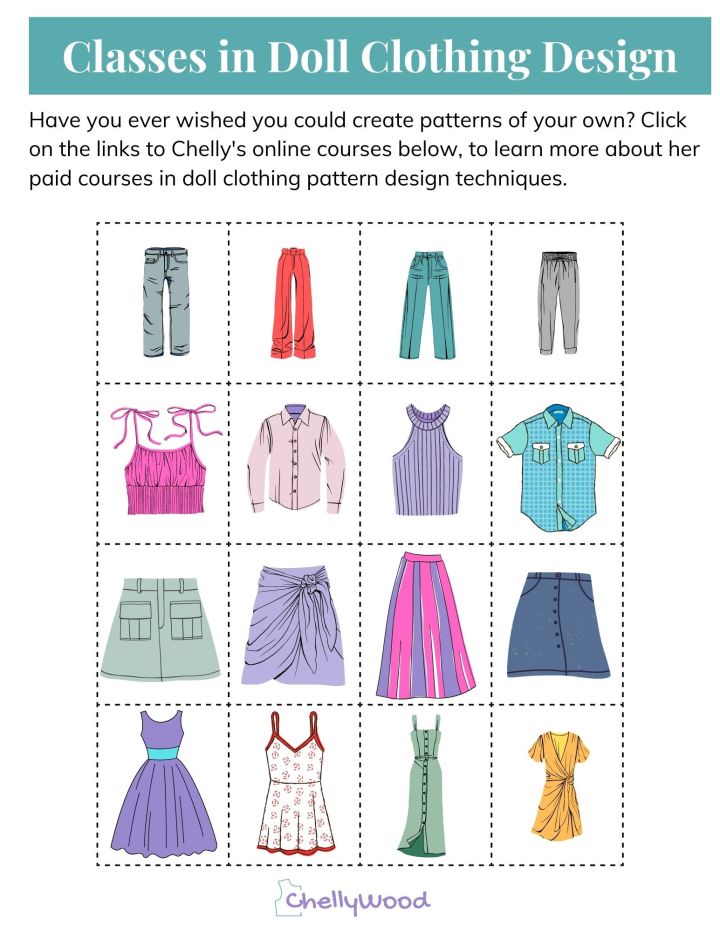
For any class on Creative Spark, you don’t have to follow a schedule. Just sign up when you’re ready.
It’s a one-time fee for the course, and there’s no specific time limit to finish your course. You can just take your time and learn at the pace that suits you. So go check out my paid courses on Creative Spark, using this link.
As always, feel free to pin, like, or tweet about my free patterns and tutorials.
To read more about my free sewing patterns and tutorials, please visit the “Helpful Tips” page.
Disclaimer/Credit/Affiliate Marketing Link:
*Please note: when you click on links to various merchants on this site and make a purchase, this can result in this site earning a commission. Affiliate programs and affiliations include Amazon, Etsy, and the eBay Partner Network. As an Amazon affiliate, I earn from qualifying purchases. To learn more about how my website uses affiliate marketing, please visit the website’s Privacy Policy page.
Chelly Wood and the ChellyWood.com website are not affiliated with the pattern company or companies mentioned in this blog post, but Chelly finds inspiration in the doll clothes designed by these pattern companies. To purchase patterns from Simplicity, McCall’s, Butterick, Vogue, or other pattern companies shown and discussed in this blog post, please click on the links provided here. These links below the “Disclaimer” section do not help raise money for this free pattern website; they are only offered to give credit to the company that made these patterns.
This turned out so cute! I love how the vintage trim adds to the whole vintage look.
Thanks for commenting, Michelle. Yes, I agree that the trim makes it really special!