

While making this lovely harvest-themed Advance 2896 View 3 skirt for a vintage Malibu Barbie, I read through the directions, and while the directions are quaint and a lot of fun to read, it may surprise you to learn that I don’t always follow them.
Sometimes I know an easier way of piecing together a garment, and I believe that’s the case with my vintage Sew-Easy by Advance “Around-the-Clock” wardrobe for Barbie, especially when it comes to the patch pockets for the View 3 skirt.
*Please note: when you click on links to various merchants on this site and make a purchase, this can result in this site earning a commission. Affiliate programs and affiliations include Amazon, JoAnn Fabric, Etsy, and the eBay Partner Network. As an Amazon affiliate, I earn from qualifying purchases. To learn more about how my website uses affiliate marketing, please visit the website’s Privacy Policy page.

As you can see, I’d already made the little blouse from View 3, and I decided to make the skirt out of the same lovely fall-colors “harvest-themed” cotton fabric.
So how did I make the pockets? Well, first I read through all the directions, which back in those days (approx. 1961) were printed on tissue paper.
As you can see in the image below, this is problematic. The tissue’s ink easily fades over time.

In case you can’t read that, it says, “Pin each pocket directly over the dotted outline on the skirt, C and stitch them into place, either by hand or machine. ‘Sew-Easy’ sewing booklet describes how to do both on page 6… ‘stitch it.'”
I did have the sewing booklet that came with Advance 2896, but it didn’t specifically address how to sew pockets. The “stitch it” section was not really a page, but more of a folded segment of the so-called booklet. And section 6 just explained how to stitch your doll’s clothes by hand vs. how to stitch them on a sewing machine.
However I think the image that accompanies these instructions shows the intended method clearly enough.

They wanted the sewist to cut out only the two pocket pieces (no linings), fold in the edges on all four sides, and stitch it to the skirt on three sides.
But that’s not what I did.

I cut out four pocket pieces: two white lining pieces and two harvest-themed outer pocket pieces. Then I sewed these together on three sides.
Next I clipped my corners with my Fiskars mini stitchers, used a chopstick to invert each pocket, and proceeded to measure and mark my skirt for a good spot where I could pin the pockets at the bottom, with the rough-edged opening up toward the waist of the skirt (see image below).

I stitched each pocket to the skirt’s harvest fabric with the pattern sides together (see left pocket, shown on the right in the photo above) and the lining facing out. If you look closely, you can see my grey stitch line along the cut edge of the pocket that’s got its lining side toward us.
Then I lifted up each pocket (like you see me doing on the left in the image above), pinned it to the skirt, and finished off the pockets by sewing on first the right side, and then the left side of each pocket. What I ended up with was this:

I used a light grey thread for the topstitching, to match the harvest fabric‘s background color, but for this blog post, I’ve shown my stitches in bright yellow, using an enhancement in Canva that allowed me to brighten up my stitches to make them easier for all of you to see.
Now that it’s all done, though, I sort of wish I’d used a contrasting fabric for my pockets because they’re kind of camouflaged with print-on-print fabric.
In the image below, you can really see what I mean. Can you even tell there are pockets there? Not really.

If I ever make this View 3 skirt and top again, using Advance 2896 vintage doll clothes patterns for Barbie, I think I’ll try using contrasting fabric for the pockets. That will make the pockets more blatantly visible in my online photos.
I might also use a contrasting fabric for the blouse as well.
What are your thoughts? Do you prefer to keep your pockets simple? Do you line them? Do you cut them extra long, fold them in half, and then press in the sides before stitching them onto the skirt? Do you baste them?
Please leave your comments in the margin.

Most of the commercial patterns I display and talk about here on ChellyWood.com are also available for sale on eBay. However, if you’ve never purchased a pattern on eBay before, it’s a good idea to read the article I wrote called, “Tips for Buying Used Doll Clothes Patterns on eBay.” It will save you time, money, and will likely prevent buyer’s remorse.
And by the way, if you use the links I’ve provided to make your eBay purchase, this website will receive a small commission, which helps fund the ChellyWood.com website, so I can continue to provide you with all the free patterns and tutorial videos offered here.
For more of my free tutorials, be sure to subscribe to my YouTube channel, ChellyWood1.
If you would like to make a donation to this free doll clothes pattern website, please click here. There’s also a “Donate” button in the main menu.
For anyone who would like to expand their dolls’ wardrobes, you should really check out my “How to Alter Doll Clothes Patterns” course and my “Design Your Own Doll Pants Patterns from Scratch” classes on the Creative Spark online learning platform. Here’s my bio page on their website, where you can learn more.
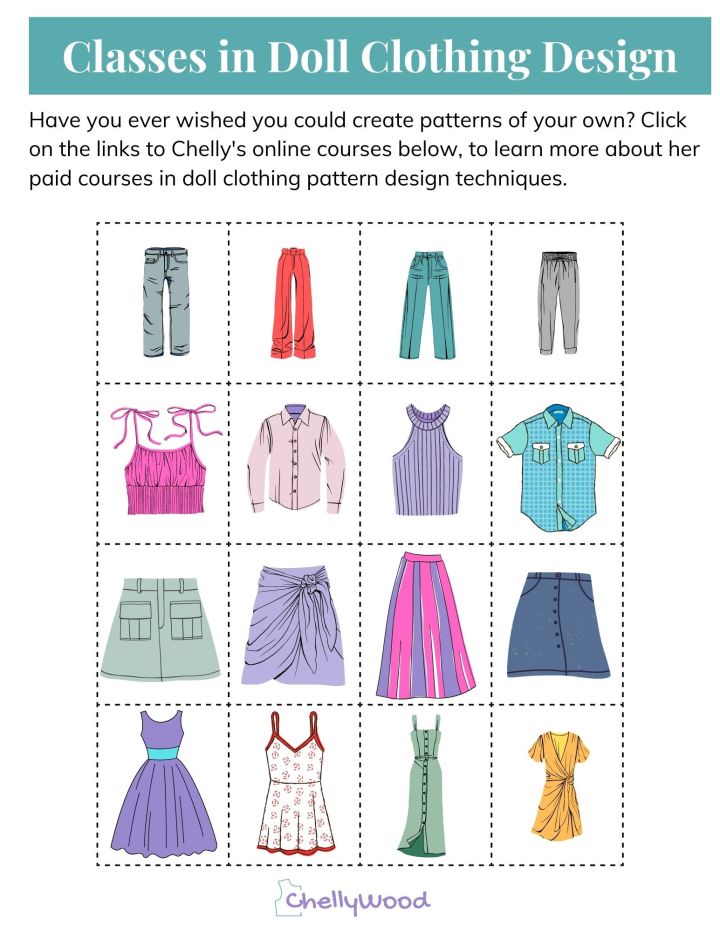
For any class on Creative Spark, you don’t have to follow a schedule. Just sign up when you’re ready.
It’s a one-time fee for the course, and there’s no specific time limit to finish your course. You can just take your time and learn at the pace that suits you. So go check out my paid courses on Creative Spark, using this link.
As always, feel free to pin, like, or tweet about my free patterns and tutorials.
To read more about my free sewing patterns and tutorials, please visit the “Helpful Tips” page.
Disclaimer/Credit/Affiliate Marketing Link:
*Please note: when you click on links to various merchants on this site and make a purchase, this can result in this site earning a commission. Affiliate programs and affiliations include Amazon, JoAnn Fabric, Etsy, and the eBay Partner Network. As an Amazon affiliate, I earn from qualifying purchases. To learn more about how my website uses affiliate marketing, please visit the website’s Privacy Policy page.
Chelly Wood and the ChellyWood.com website are not affiliated with the pattern company or companies mentioned in this blog post, but Chelly finds inspiration in the doll clothes designed by these pattern companies. To purchase patterns from Simplicity, McCall’s, Butterick, Vogue, or other pattern companies shown and discussed in this blog post, please click on the links provided here. These links below the “Disclaimer” section do not help raise money for this free pattern website; they are only offered to give credit to the company that made these patterns.