

Recently I made a denim version of the View 1 dress from my Simplicity 4883 sewing pattern for vintage Ideal Tammy dolls. I used a lightweight denim fabric that had a soft pastel floral print pattern on it, but there was a very SMALL amount of this fabric available.
It was really just three long thin strips of fabric, and that’s all.
So I had to make some alterations, in order to make it work. Today’s blog post will share my sewing hacks for making doll clothes with a limited amount of fabric, just like I did for this project.

But before we get underway, I need to make my required affiliate marketing statement…
When you click on links to various merchants on this site and make a purchase, this can result in this site earning a commission. Affiliate programs and affiliations include Amazon, JoAnn Fabric, Etsy, and the eBay Partner Network. As an Amazon affiliate, I earn from qualifying purchases. To learn more about how my website uses affiliate marketing, please visit the website’s Privacy Policy page.

In Figure 1 above, you can see that the instruction page for Simplicity 4883 suggested that I cut out a ruffle for the dress and double the fabric, by folding it in half (like a hot dog) before gathering the ruffle along the raw edge.
Except, as you can see in Figure 2, I only had a long thin strip of the pastel floral denim fabric. I really wanted to see what this dress would look like in my floral denim though!
So I decided to take on the challenge of working with the tiny strips of fabric I did have, regardless of the fact that this would be tricky. And honestly, I wasn’t sure it was going to work when I first got started.

Tip #1 for working with a limited amount of fabric is this: use a secondary fabric.
In the image above, you can see that I decided to use a pink and white gingham as a secondary fabric. Of course the original pattern and its instruction sheet didn’t offer any instructions for using this secondary fabric, so I had to get creative.
In Figure 3 (above), you can see that I cut the gingham a little longer than the pattern called for (see the white arrow), and I cut the pink gingham as wide as the pattern but as long as the skinny swatch of denim (see the yellow arrow).
Then, as shown in Figure 4, I hemmed both ruffles, but the denim fabric only got a single-fold hem while the pink gingham got the usual double-fold hem. I gathered the two of them together along the raw, unhemmed long edge, as a pair.

Now, when I was making the dress front, I once again found that I didn’t have quite enough fabric to cut Simplicity 4883‘s entire dress front pattern piece on the fold, as the pattern instructions suggested (see Figure 5), but I could just barely fit the pattern on the swatch of folded fabric with only the edge of the dart’s tip hanging over the cut side of the fabric.
I knew that if I cut it out carefully, I could skip over the dart’s tip (see Figure 6) because the tip of the dart isn’t needed. As shown in Figures 7 and 8 above, I ended up cutting away the triangular-shaped inside part of the dart anyway, so the dart’s tip was not a loss of necessary fabric.
So Tip #2 for working with a limited amount of fabric: Don’t bother cutting out bits that won’t show in the final product.

I stitched my paired ruffles onto the base of the dress entirely by hand because the denim ruffle was very narrow, and sewing by hand allowed me to use the smallest possible seam allowance, giving the denim ruffle a bit more visibility.
That brings me to Tip #3 for working with a limited amount of fabric: sew by hand to save space on seam allowances.
And as you can see in Figure 10, I’ve used the pink gingham fabric as a lining for the dress, even though the pattern instructions didn’t call for a lining. But I find that when you line a doll’s garment, it gives you a nicer seam around neck and arm openings.
Tip #4 for working with a limited amount of fabric is this: line the dress or shirt with the secondary fabric.
And on the whole, I think the View 1 dress from my Simplicity 4883 vintage Tammy doll clothes pattern turned out really well!

I had a very teeny-tiny swatch of the floral denim fabric left when it was all done, and I used this to make the little purse that Tammy’s holding in the image above.
And therefore, Tip #5 can be stated as follows: choose projects that are realistic for the amount of fabric you do have.
And that’s it for my sewing hacks on Simplicity 4883 and how to work with a limited amount of fabric.


Most of the commercial patterns I display and talk about here on ChellyWood.com are also available for sale on eBay. However, if you’ve never purchased a pattern on eBay before, it’s a good idea to read the article I wrote called, “Tips for Buying Used Doll Clothes Patterns on eBay.” It will save you time, money, and will likely prevent buyer’s remorse.
And by the way, if you use the links I’ve provided to make your eBay purchase, this website will receive a small commission, which helps fund the ChellyWood.com website, so I can continue to provide you with all the free patterns and tutorial videos offered here.
For more of my free tutorials, be sure to subscribe to my YouTube channel, ChellyWood1.
If you would like to make a donation to this free doll clothes pattern website, please click here. There’s also a “Donate” button in the main menu.
For anyone who would like to expand their dolls’ wardrobes, you should really check out my “How to Alter Doll Clothes Patterns” course and my “Design Your Own Doll Pants Patterns from Scratch” classes on the Creative Spark online learning platform. Here’s my bio page on their website, where you can learn more.
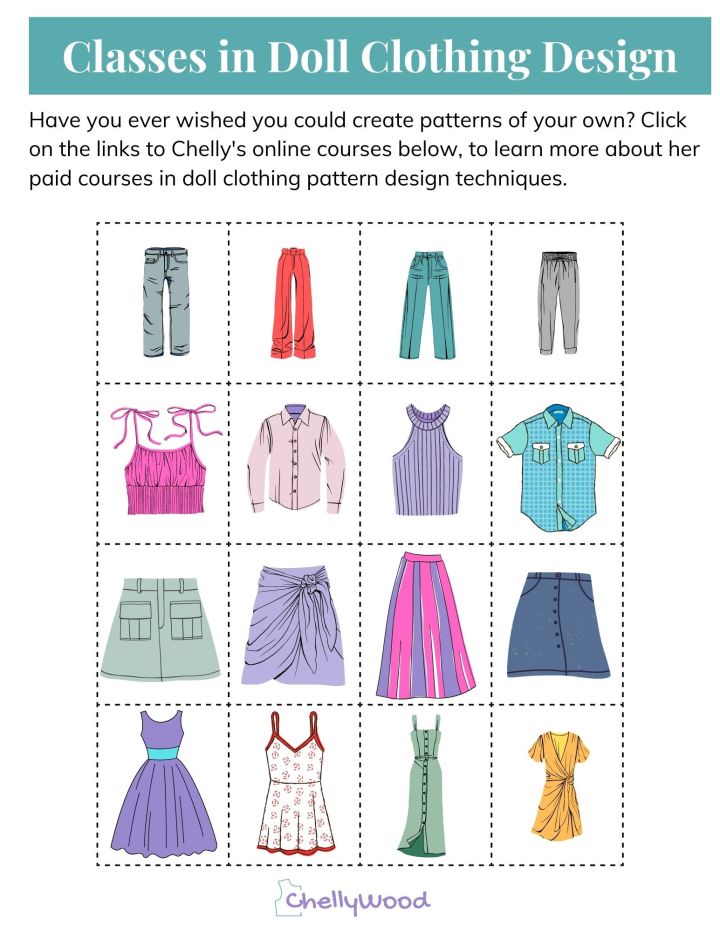
For any class on Creative Spark, you don’t have to follow a schedule. Just sign up when you’re ready.
It’s a one-time fee for the course, and there’s no specific time limit to finish your course. You can just take your time and learn at the pace that suits you. So go check out my paid courses on Creative Spark, using this link.
As always, feel free to pin, like, or tweet about my free patterns and tutorials.
To read more about my free sewing patterns and tutorials, please visit the “Helpful Tips” page.
Disclaimer/Credit/Affiliate Marketing Link:
*Please note: when you click on links to various merchants on this site and make a purchase, this can result in this site earning a commission. Affiliate programs and affiliations include Amazon, JoAnn Fabric, Etsy, and the eBay Partner Network. As an Amazon affiliate, I earn from qualifying purchases. To learn more about how my website uses affiliate marketing, please visit the website’s Privacy Policy page.
Chelly Wood and the ChellyWood.com website are not affiliated with the pattern company or companies mentioned in this blog post, but Chelly finds inspiration in the doll clothes designed by these pattern companies. To purchase patterns from Simplicity, McCall’s, Butterick, Vogue, or other pattern companies shown and discussed in this blog post, please click on the links provided here. These links below the “Disclaimer” section do not help raise money for this free pattern website; they are only offered to give credit to the company that made these patterns.