I’ve been sewing with vintage McCall’s 9449 and here’s what I’ve learned about sleeve elastic! #Sewing #Vintage

The Chelly Wood doll holds up a vintage McCall's 9449 doll wardrobe pattern, which says near the top of the envelope, "Wardrobe for chubby baby and toddler dolls" and is also noted as being for the smaller size of dolls, which is indicated to be 12 inches to 16 inches tall. The patterns shown are as follows: view A = a red long-sleeved dress with cuffs overlaid by an orange jumper (in the American understanding of this word) with a V-shaped yoke; View B = a dress with long sleeves that end in ruffle cuffs and have a ruffle cuff neckline along with a squared yoke bodice; View C = a white pinafore over blue long-sleeved dress with ruffle collar and ruffle cuffs (identical to the long-sleeved dress shown in view B; View D = a long bathrobe with ribbon tie; View E = a sleeveless nightgown that is floor-length, shown in white with red trim to match the red check bathrobe; View F = a beret and matching blue coat that has pockets in front; view G = a long-sleeved red dress with a white collar trimmed in lace (also having the ruffle sleeves but these ruffle cuffs are also trimmed in white lace).
Please visit ChellyWood.com for free printable sewing patterns for making doll clothes to fit dolls of many shapes and all different sizes.

My niece has a birthday coming up, and I’ll be giving her an 18 inch American Girl doll this year. I’ve made her a few doll clothes with my own, personally-designed patterns, of course, and I’ve also been experimenting with Simplicity 5276 (a modern pattern).

But for my favorite outfit I’ve made so far, I used my re-sizing formula to adapt the pattern for making the little jumper dress (in the US sense of “jumper”) shown in View A on my vintage McCall’s 9449 pattern for 12 to 16 inch baby dolls. And I’ve made another adaptation too…

Here we see the McCall's chubby baby doll pattern number 9449 laying on a surface with dress front and back pattern pieces lying nearby. The dress front is shorter than the dress back piece, but the yoke, which lays near the dress front piece, once attached to the front piece, will make it comparable to the size of the dress back piece.
Please visit ChellyWood.com for free printable sewing patterns for making doll clothes to fit dolls of many shapes and all different sizes.

But before we go any further into this blog post, I need to make my disclaimer statement…

*Please note: when you click on links to various merchants on this site and make a purchase, this can result in this site earning a commission. Affiliate programs and affiliations include Amazon, JoAnn Fabric, Etsy, and the eBay Partner Network. As an Amazon affiliate, I earn from qualifying purchases. To learn more about how my website uses affiliate marketing, please visit the website’s Privacy Policy page.

In Figure 1, we see the front of a dress or tunic pattern for McCall's doll clothes pattern 9449 View A, as it looks inside-out with a white yoke and a yellow print bodice front that has two bodice pieces sewn together right in the middle and attached at the bottom of the yoke. Figure 2 shows the same tunic style dress, but from the right side, and in this image, the yoke is made of the yellow printed fabric instead of the solid white cotton. In Figure 3, a woman's hand places a back against the same front, and we can see that the back piece is made of the yellow printed fabric on the right side and the white cotton as a lining on the wrong side. In figure 4, the whole bodice lays flat with the backs sewn to the front at the shoulder seams. Again, it's noticeable that the bodice uses the pretty bright yellow printed fabric on its outside while the white is used for the lining of the yoke and both back pieces.
Please visit ChellyWood.com for free printable PDF sewing patterns for making doll clothes to fit dolls of many shapes and all different sizes.

As you can see in the images above and in the artwork on the envelope, this is meant to be a little sleeveless number, and in fact, on the cover art, we can see that the doll in View A is wearing the red long-sleeved dress under the jumper.

But of course that’s not what I did. I actually made the sleeveless version a couple of years ago, and when I tried it on my 12 inch Baby Alive doll, I found that the sleeve openings were quite large, as you’ll see here:

The image shows a Baby Alive 12 inch doll modeling a handmade dress from McCall's 9449 vintage doll wardrobe pattern (view A), but in the photo, we can clearly see the bloomers showing underneath the jumper-style dress through the armhole.
Please visit ChellyWood.com for free printable sewing patterns for making doll clothes to fit dolls of many shapes and all different sizes.

To see that earlier blog post, just click here.

Anyway, that got me thinking that maybe with a little up-sizing, I could get my jumper to fit the American Girl dolls. So that’s exactly what I set out to do.

Except, I wanted my sleeves to be attached to the jumper, forming a whole dress with alternate-colored sleeves.

Figure 5 shows a woman's hand holding a white cotton sleeve up to a yellow cotton print bodice, so she can begin attaching the sleeve at the underarm area of the bodice. Figure 6 shows the sleeve after it has been attached to the bodice. The end of the sleeve has been folded and pressed for hemming. Figure 7 zooms in on the end of the sleeve to show that the end of the sleeve is, indeed folded and pressed, but not yet hemmed. Beside it lays a swatch of lace that is meant to be sewn onto the folded and pressed area at the end of the sleeve. Figure 8 shows the lace being sewn to the folded and pressed edge of the sleeve, under a sewing machine's presser foot. We can see that even in the sew-on stage, the sleeve was not actually hemmed, but just folded and pressed with an iron before attaching the lace edging to the bottom of the sleeve.
Please visit ChellyWood.com for free printable PDF sewing patterns for making doll clothes to fit dolls of many shapes and all different sizes.

As you can see in Figures 7 and 8 above, I didn’t hem the end of the sleeve first.

I just folded the end of the sleeve, pressed it, and began sewing a flat piece of lace trim right over the top of the folded ready-to-hem area. This saved one step in the process.

The image shows "figure 9" in the upper right hand corner. This is a close-up image of the tunic from View A of McCall's 9449 vintage sewing pattern for toddler dolls. In this mage, we can see that the lace has been sewn to the bottom of both sleeves, and the sleeves have been hemmed prior to sewing the lace onto the end of each sleeve. The tunic lies flat, forming a sort of T-shape with the sleeves extended and laying flat on the cutting mat. The bodice, in two pieces, is sewn together at the shoulders, but not yet sewn at the side seams. The sleeves are made of white cotton fabric, contrasting the yellow of the bodice's outer fabric.
Please visit ChellyWood.com for free printable PDF sewing patterns for making doll clothes to fit dolls of many shapes and all different sizes.

However I probably should have used straight pins to hold it in place while I sewed the lace to the bottom of each sleeve. My seams were a little uneven, but not too bad.

Next, I sewed some elastic directly onto the bottom of each sleeve.

In figure 10, we see that a lace trim was added to the end of a sleeve. In figure 11, we can read the specs on the elastic as follows: "quarter inch braided elastic, .25 inch by 8 yards or .64 centimeters by 7.32 meters)" with the company name, Dritz appearing in one corner of the label. Made in China also appears on the green paper label that surrounds the braided elastic. In figure 12, a sewing machine's presser foot has been lowered onto the elastic to hold it in place at the point where the lace meets the cotton fabric of the sleeve in one corner of the sleeve. It looks like the sewist is about to start sewing the elastic onto the inside of the sleeve, just below the line of lace. In figure 13, the elastic has been sewn onto the sleeve. A woman holds the sleeve open for us to see that the elastic has not yet been cut away from the edge of the sleeve, and in fact, we see the skein of braided elastic sitting on the cutting mat. A graphic of purple-handled scissors floats above the photo, pointing toward the edge of the sleeve where the elastic is still attached to the cotton of the sleeve, indicating that the sewist should cut the elastic away from the skein here.
Please visit ChellyWood.com for free printable PDF sewing patterns for making doll clothes to fit dolls of many shapes and all different sizes.

You’ll notice in Figure 13 above, that I don’t actually cut the elastic to fit the sleeve. Instead, I keep it attached to the skein of elastic until it has been sewn onto the sleeve. Then I cut it free.

I took a brief video of myself sewing the elastic onto the sleeve (Figure 12 above).

This video footage later became the video tutorial “short” that I posted at the end of March, called, How to Sew Elastic Directly to Fabric, which you can view again right here, if you didn’t see it on my YouTube channel when it first came out.

Once you get the elastic sewn to the bottom of the sleeves, your sleeves are going to curl inward (see Figure 14 below for an image).

This is a bit of a hassle, but after you fold the sleeves to stitch the side seams from cuff to hem (shown below in Figure 15), it calms the wildness of the curling elastic. I pinned the sleeves’ raw edges together with a straight pin too, before I started to stitch the side seams, and that also helped to counter the curling effect.

On top we see Figure 14, which shows the tunic style dress after sleeves have had elastic sewn on. The dress lays open with the whole thing flat against a cutting mat, not having had the side seams sewn yet. The elastic at the edges of the sleeves is curling from the sew-on elastic. Figure 15, at the bottom of the image, shows the tunic after it has been folded but before the side seams have been sewn. Now we can see that the sleeves' elastic cuffs look gathered where the elastic has been sewn to the bottom of the sleeve. These images accompany an article about sewing elastic into a garment from McCall's pattern 9449, a vintage doll clothes sewing pattern from the 1960's.
Please visit ChellyWood.com for free printable PDF sewing patterns for making doll clothes to fit dolls of many shapes and all different sizes.

The final project is a sweet little tunic-style dress, which was a little shorter than I had expected it to be. So I made a pair of white bloomers to go with it. But if I were to make another one of these tunic-style dresses from McCall’s 9449, I’d just lengthen it another two inches, I think.

Now as I said before, I had to up-size the original McCall’s 9449 pattern because it was designed for 12 to 16 inch baby dolls, and I also altered it by adding a sleeve.

Kaya faces forward in her handmade doll clothes. We can see that the bright yellow dress is made of vintage fabric with a pattern of tiny multicolored umbrellas scattered across the yellow cotton. The dress has a yoke in front, also made of the yellow cotton printed with tiny umbrellas. The sleeves of the dress are white cotton, as are the bloomers, which are visible under the dress. The doll wears dressy white shoes to accompany her handmade dress and bloomers.
Please visit ChellyWood.com for free printable sewing patterns for making doll clothes to fit dolls of many shapes and all different sizes.

Do you see how Kaya’s dress’s yellow fabric is printed with tiny umbrellas? How sweet is that?! It’s actually a vintage fabric, which I had been given very little of because… well… that’s all my mother-in-law had of it.

By using the white fabric for the lining and the sleeves and the bloomers, I was able to make this beautiful vintage yellow umbrella print fabric stretch enough to create the jumper part of the dress, without running out of fabric. So that was a handy trick!

In one photo, Kaya, the American Girl First Nations girl, is turned to the viewer's right (slightly) as she models her handmade tunic made of yellow cotton fabric with long white sleeves trimmed in lace that's gathered at the cuff. In the other photo (the one on the right), the Kaya doll looks toward the viewer's left and again, she wears her handmade tunic dress with long white sleeves and a yellow A-line jumper-style shape. Under the dress in both photos, she wears handmade bloomers that are also gathered with elastic at the knee. Her shoes are patent leather mary janes.
Please visit ChellyWood.com for free printable sewing patterns for making doll clothes to fit dolls of many shapes and all different sizes.

If you don’t know how to alter doll clothes patterns, up-sizing them, down-sizing them, adding sleeves to sleeveless garments, etc., like I did when I adapted this McCall’s 9449 vintage pattern (originally meant for 12 to 16 inch baby dolls), then my “How to Alter Doll Clothes Patterns” course might be very helpful to you.

You can read more about it in the area just below…

This image of a turquoise blue sewing needle pulling purple thread away from a line of cross-stitching is used as a divider between sections of a blog post.

Most of the commercial patterns I display and talk about here on ChellyWood.com are also available for sale on eBay. However, if you’ve never purchased a pattern on eBay before, it’s a good idea to read the article I wrote called, “Tips for Buying Used Doll Clothes Patterns on eBay.” It will save you time, money, and will likely prevent buyer’s remorse.

And by the way, if you use the links I’ve provided to make your eBay purchase, this website will receive a small commission, which helps fund the ChellyWood.com website, so I can continue to provide you with all the free patterns and tutorial videos offered here.

For more of my free tutorials, be sure to subscribe to my YouTube channel, ChellyWood1.

If you would like to make a donation to this free doll clothes pattern website, please click here. There’s also a “Donate” button in the main menu.

For anyone who would like to expand their dolls’ wardrobes, you should really check out my “How to Alter Doll Clothes Patterns” course and my “Design Your Own Doll Pants Patterns from Scratch” classes on the Creative Spark online learning platform. Here’s my bio page on their website, where you can learn more.
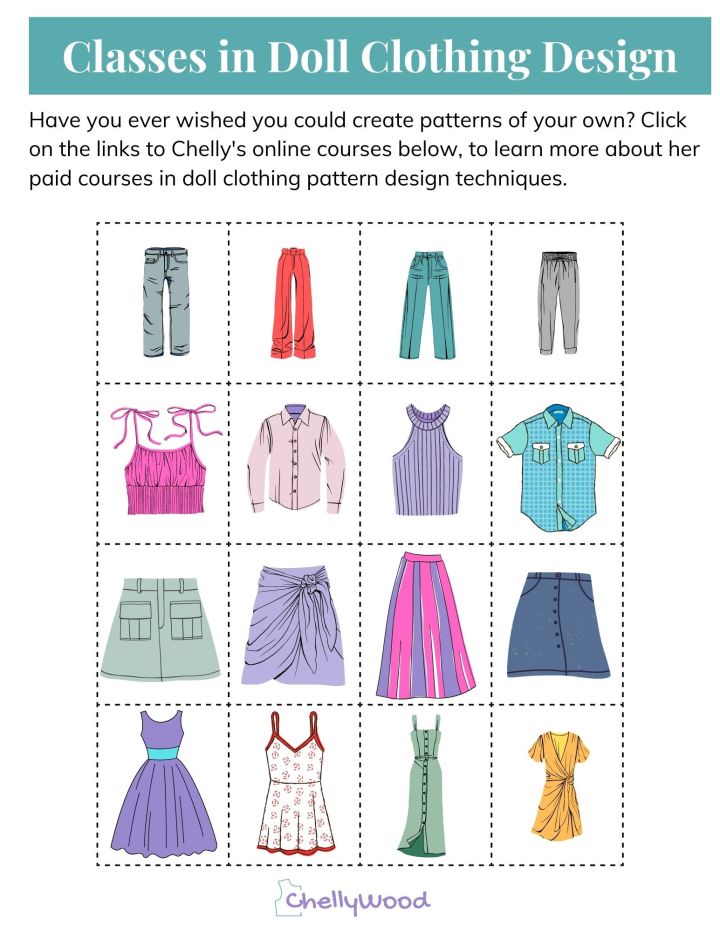
This image shows four rows of artist's renderings of doll clothing items. The top row shows four different styles of pants. The second row shows four different styles of shirts. The third row shows four different styles of skirts. The fourth row shows four different styles of dresses, with skirts in long, short, and mid-length styles. The text reads at the top, "Classes in Doll Clothing Design" followed by this paragraph: "Have you ever wished you could create patterns of your own? Click on the links to Chelly's online courses below, to learn more about her paid courses in doll clothing pattern design techniques."

For any class on Creative Spark, you don’t have to follow a schedule. Just sign up when you’re ready.

It’s a one-time fee for the course, and there’s no specific time limit to finish your course. You can just take your time and learn at the pace that suits you. So go check out my paid courses on Creative Spark, using this link.

As always, feel free to pin, like, or tweet about my free patterns and tutorials.

To read more about my free sewing patterns and tutorials, please visit the “Helpful Tips” page.

Disclaimer/Credit/Affiliate Marketing Link:

*Please note: when you click on links to various merchants on this site and make a purchase, this can result in this site earning a commission. Affiliate programs and affiliations include Amazon, JoAnn Fabric, Etsy, and the eBay Partner Network. As an Amazon affiliate, I earn from qualifying purchases. To learn more about how my website uses affiliate marketing, please visit the website’s Privacy Policy page.

Chelly Wood and the ChellyWood.com website are not affiliated with the pattern company or companies mentioned in this blog post, but Chelly finds inspiration in the doll clothes designed by these pattern companies. To purchase patterns from Simplicity, McCall’s, Butterick, Vogue, or other pattern companies shown and discussed in this blog post, please click on the links provided here. These links below the “Disclaimer” section do not help raise money for this free pattern website; they are only offered to give credit to the company that made these patterns.

One thought on “I’ve been sewing with vintage McCall’s 9449 and here’s what I’ve learned about sleeve elastic! #Sewing #Vintage

  1. This type of pattern would be good for my 12″ and 14″ Patsy Anne dolls. They are quite a bit chubbier in the tummy than modern dolls of the same height.

Leave a Reply

This site uses Akismet to reduce spam. Learn how your comment data is processed.