

In years past, I’ve done different blog posts on various topics related to Black History Month in February, but this is the first time I’ve begun the celebration by delving into the traditional clothing of various African nations.
It was really fun to learn all about the traditional clothing of African countries, regions, and tribes, but we only have so many blog posts in February… So I’ve narrowed it down to four traditional clothing styles that I want to cover.

I’m going to post a little snippet of information about traditional African clothes once a week throughout the month of February. Some of these blog posts are quite long, but with each, I’ve spent hours doing extensive research, and I want to share what I’ve learned.
Please don’t navigate away from my website, just because the blog posts are long. I want to hear your feedback and comments after you’ve read about each item of clothing, so please read them and form opinions of your own.
I’ll give you plenty of links to help you find more information, if you’re interested in learning more about each style of clothing.
Watch for the Black History Month thumbnail below. I will be using that thumbnail for each of the four different styles of traditional clothing I’ll cover in February.

I tried to focus my research on the nations that surround the area known as West Central Africa, mainly because this is where many Americans of African heritage can trace their roots to. I’m an American citizen, and as part of this celebration of the rich history of African Americans, I wanted to take a good look at the traditional clothing that people from these countries would have worn and/or still wear today.
Having done, as I’ve said, many hours of research, I will also hypothesize about how some of these traditional African clothing styles have impacted American fashion styles throughout history, and even today. I hope you enjoy the work I’ve put into this project, and I also hope I don’t offend anyone with my fashion hypotheses.

It has given me a lot to think about, and truthfully, I started this research, at least in part, because I thought it might inspire me to design some traditional African clothing for some of my dolls, but now that I look back on the study I’ve done, it has become a much bigger inspiration than I could have ever imagined.
I’m going to end today’s blog post by directing you to the jumping-off point, where I first began my research. It’s a website called (to nobody’s surprise at all) Africa.com. It lists all 54 of the nations of modern-day Africa, and it offers a link to further your exploration into each one.

If you enjoyed this blog post, and you’d like to see my videos, you might want to navigate over to my YouTube channel, ChellyWood1 to look through my playlists.
If you would like to make a donation to this free doll clothes pattern website, please click here. There’s also a “Donate” button in the main menu.
For anyone who would like to expand their dolls’ wardrobes, you should really check out my “How to Alter Doll Clothes Patterns” course and my “Design Your Own Doll Pants Patterns from Scratch” classes on the Creative Spark online learning platform. Here’s my bio page on their website, where you can learn more.
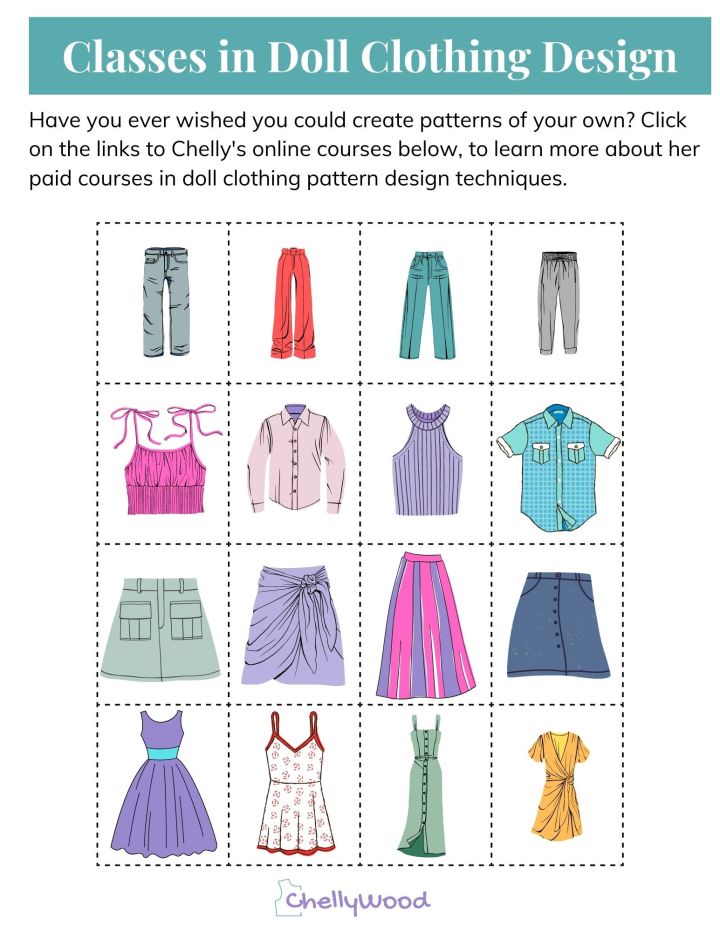
For any class on Creative Spark, you don’t have to follow a schedule. Just sign up when you’re ready.
It’s a one-time fee for the course, and there’s no specific time limit to finish your course. You can just take your time and learn at the pace that suits you. So go check out my paid courses on Creative Spark, using this link.
As always, feel free to pin, like, or tweet about my free patterns and tutorials.
To read more about my free sewing patterns and tutorials, please visit the “Helpful Tips” page.
Disclaimer/Credit/Affiliate Marketing Link:
*Please note: when you click on links to various merchants on this site and make a purchase, this can result in this site earning a commission. Affiliate programs and affiliations include Amazon, JoAnn Fabric, Etsy, and the eBay Partner Network. As an Amazon affiliate, I earn from qualifying purchases. To learn more about how my website uses affiliate marketing, please visit the website’s Privacy Policy page.
Chelly Wood and the ChellyWood.com website are not affiliated with any of the doll or toy companies mentioned in this blog post, but Chelly enjoys designing her doll clothes to fit a variety of dolls. To learn more about the doll companies mentioned in today’s post, please visit the doll or toy company’s website.